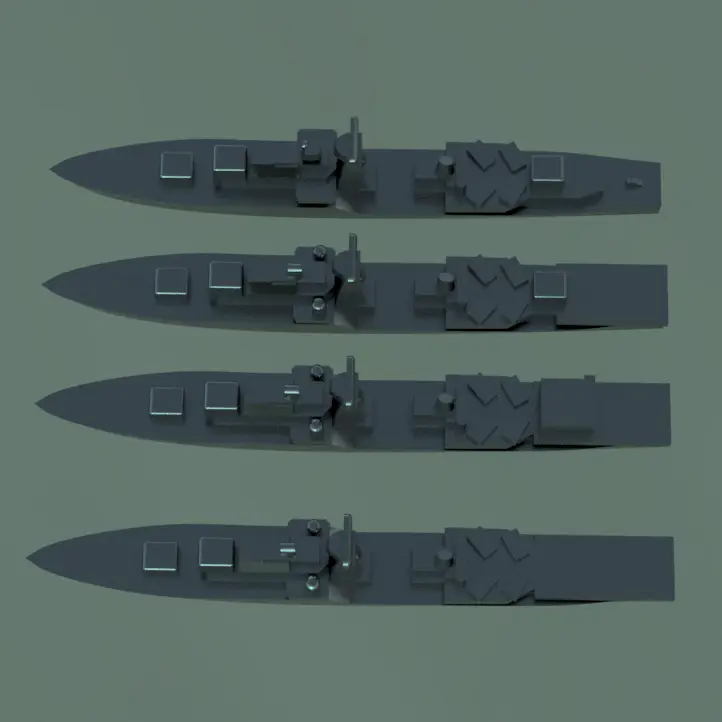
1/6000 and 1/3000 Peruvian Daring Class Destroyers
por EDWARD MCENEELY en Thingiverse
The Royal Navy largely retired their Daring-class destroyers by the end of the 1960s. The ships weren't much bigger or more crew-intensive than a Leander-class frigate, but their capability gulf was large: the Darings were designed to fight other ships within visual range, and had limited ASW and...
Licencia
Uso comercial permitidoCC BY-SA 4.0 — Atribución, compartir igual
Puedes usarlo y modificarlo dando crédito; las versiones modificadas deben compartirse con la misma licencia.
Al descargar aceptas respetar la licencia y dar crédito a EDWARD MCENEELY.
Archivos (12)
- Daring_Ferre_1973_base.stl STL
- Daring_Ferre_1973.stl STL
- Daring_Ferre_1973_3000.stl STL
- Daring_Ferre_1978_base.stl STL
- Daring_Ferre_1978.stl STL
- Daring_Ferre_1978_3000.stl STL
- Daring_Palacios_198x_base.stl STL
- Daring_Palacios_198x.stl STL
- Daring_Palacios_198x_3000.stl STL
- Daring_Palacios_1978_base.stl STL
- Daring_Palacios_1978.stl STL
- Daring_Palacios_1978_3000.stl STL
- Categoría
- Juguetes y juegos
- Formatos
- STL
- Descargas
- 5
- Publicado
Sobre este modelo
The Royal Navy largely retired their Daring-class destroyers by the end of the 1960s. The ships weren't much bigger or more crew-intensive than a Leander-class frigate, but their capability gulf was large: the Darings were designed to fight other ships within visual range, and had limited ASW and anti-aircraft capabilities. The Leanders, on the other hand, had better sonar, provision for a helicopter, Sea Cat SAMs, and the more modern (and much heavier) Limbo ASW mortar in place of the Darings' aging Squid, without even getting into the question of their far superior crew comfort. To refit the Darings to even a secondary standard would cost almost as much as replacing them. Western-aligned Latin American navies were expected to assist the US with antisubmarine warfare in the event of a shootin' war with the Rooskies (the annual USN-Latin American joint UNITAS exercises, started in 1960, were initially entirely-ASW focused, though by 1978, "only" 70% was devoted to anti-submarine warfare), but in 1968, Peru's democratically-electedpresident was overthrown by General Juan Alvarado, head of the Peruvian armed forces. Alvarado, unusually for a military officer, leaned left, and his first act was to nationalize the oil industry in Peru, which started a period of mutual antipathy with the United States that lasted for most of his reign. The USA had always been parsimonious with military sales to South America, hoping to preserve the balance of power and avoid any arms races that might lead to war, and so as the 1960s came to an end, many Latin American nations turned to European suppliers for more modern weapons. Peru, with its leftward lean, bought from the United Kingdom (as did Chile under Allende), in 1969 under Labour Prime Minister Harold Wilson (in 1973, when they bought their cruisers from the Netherlands, Conservative Edward Heath was PM in UK, while Joop Den Uyll led what's considered to be the most left-wing Dutch cabinet of the 20th century from 1973-77). (It should also be noted that Peru bought a substantial number of T-55s from the Soviet Union, which can't have done anything good for relations with the USA.) HMS Diana and Decoy were sold to Peru, although as part of the purchase was an extensive refit, they weren't delivered until 1973, virtually long enough to have built entirely new ships. As delivered, they had removed the remaining bank of torpedo tubes and added a platform between X turret and the after funnel (which received a streamlined fairing; the hideous appearance of the funnel had long been a subject of complaint in the Royal Navy, but the ships lacked sufficient reserves of topweight to do anything about it) with four twin Exocet launchers on it. These were then brand-new weapons, not being adopted for service in France until 1975, and still undergoing testing in 1973, so Peru was well and truly on the cutting edge of military technology with them. The foremast was also rebuilt and enclosed, and now sported a Plessy AWS-1 air search radar (originally intended only for export, but which the Royal Navy in 1971 discovered had excellent performance when a surprise coup resulted in them receiving a ship intended for sale to Ghana). In 1975 (around when Alvarado was replaced in a coup by Francisco Bermúdez and Peru's relationship with the USA warmed somewhat), the destroyers were refitted again, losing their Squid ASW mortars and adding a helicopter deck abaft X turret. Scarcely was this completed in 1976 when the two ships were AGAIN refitted. Ferré (ex-Decoy) and Palacios (ex-Diana) both had their bridge wing Bofors guns replaced with dome-like OTO Melara twin 40mm turrets, and their British-built MRS-3 directors were replaced by Italian AESN NA-10 directors. Palacios also landed X turret and replaced it with a telescoping hangar. This does not appear to have been a success, however, as some time in the 1980s it was removed (my copy of Jane's Fighting Ships 1985-1986 doesn't specify a date), though the turret was not replaced at that time. The Peruvians seem to have liked the ships; they also bought destroyers from the Netherlands (one Holland-class in 1978, and seven[!!!] Friesland-class in 1980-81), but Palacios and Ferré outlasted them all, the former being stricken in 1993, and Ferré being decommissioned in 2007, 54 years after she'd entered British service. There are multiple iterations of the ships here; the process was complicated by the fact that I have a hobbyist license for Fusion 360 and can only have ten files active at a time, so for part of this, I was exporting my work there to work on it in SolidCraft, not a very efficient or smart way to do things. So, what you get is: Ferre 1973: Both ships in as-delivered condition, with their original British director, no helipad, and their Exocets. Ferre 1978: Ferré after her second refit in Peruvian service, with the OTO Melara bridge wing turrets, new Italian director, and helipad. Palacios 1978: Palacios after her second refit, with the new Italian director, OTO Melara in the bridge wings, helipad, and the hangar replacing X turret. Palacios 198x: Palacios after the removal of the telescoping hangar. The versions with sea bases use a resized version of VSadnik3D's Sea Base (Small): https://www.thingiverse.com/thing:4840056/files
Descripción original del autor, publicada en Thingiverse.