Yokai D&D - The Can't Stop Kinko
por Grant Miller en Thingiverse
The Can't Stop Kinko As part of a larger dungeon-crawler-style project, middle schoolers traversed through several rooms to encounter challenges inspired by Japanese folklore. In this room, they faced the Kinko and its temptation to test their understanding of probability with this classic...
Licencia
Uso comercial permitidoCC BY-SA 4.0 — Atribución, compartir igual
Puedes usarlo y modificarlo dando crédito; las versiones modificadas deben compartirse con la misma licencia.
Al descargar aceptas respetar la licencia y dar crédito a Grant Miller.
- Categoría
- Educación
- Formatos
- STL
- Descargas
- 0
- Publicado
Sobre este modelo
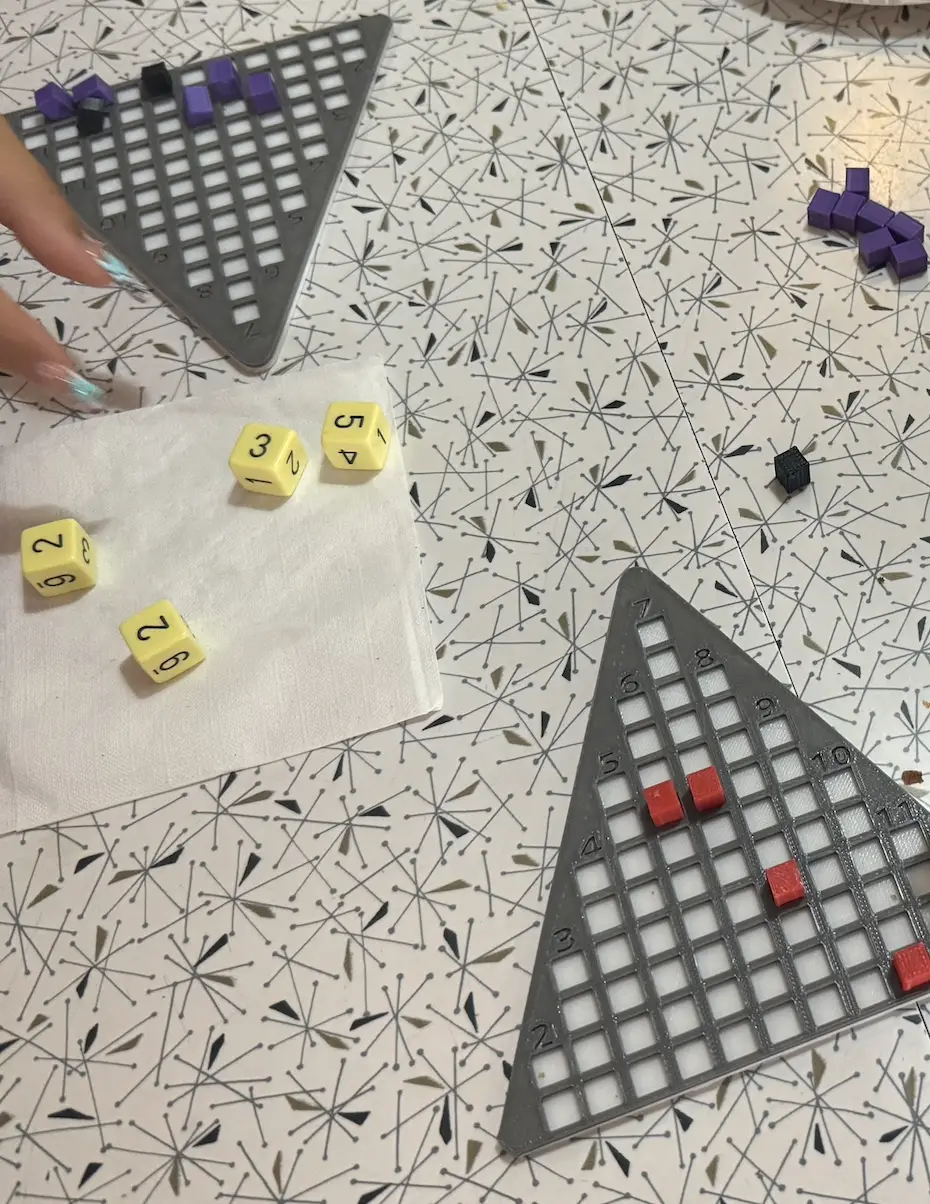
The Can't Stop Kinko As part of a larger dungeon-crawler-style project, middle schoolers traversed through several rooms to encounter challenges inspired by Japanese folklore. In this room, they faced the Kinko and its temptation to test their understanding of probability with this classic "press-your-luck" game Sid Sackson developed in the 1980s. The Kinko Known for its distinctive cup-shaped body, the Kinko uses its wings made of playing cards and fox-like legs and tail to dance about the room. The Kinko is often associated with Chō-Han, a dice game that uses a cup, and Oicho-Kabu, a betting card game. Folklore tells of a time when government officials ordered hunting parties to exterminate these Yōkai and the habitual gambling they represent, but these efforts were never successful. Can't Stop In the early 1980s, Mathematician Sid Sackson's game of probability hit the shelves and remains a classic that is still in print. Board Game Geek describes it as the following: "The board has one column for each possible total of two six-sided dice, but the number of spaces in each column varies: the more probable a total, the more spaces in that column and the more rolls it takes to complete. On their turn, a player rolls four dice and arranges them in duos: 1 4 5 6 can become 1+4 and 5+6 for 5 & 11, 1+5 and 4+6 for 6 & 10, or 1+6 and 4+5 for 7 & 9. The player places or advances progress markers in the open column(s) associated with their chosen totals, then chooses whether to roll again or end their turn and replace the progress markers with markers of their color. A player can only advance three different columns in a turn and cannot advance a column which any player has closed out by reaching the end space; if a roll doesn’t result in any legal plays, the turn ends with that turn’s progress lost." Credit: This activity was developed by Dr. Grant R. Miller and is part of the Educating with Evidence project at Southern Illinois University. It was created with funding from a regional grant through the Library of Congress' Lewis-Houghton Civics and Democracy Initiative (https://www.loc.gov/programs/teachers/teaching-with-primary-sources-partner-program/lewis-houghton/). Image of Kinko from Yokai.com. Bestiary background image is from the Library of Congress' Free to Use and Reuse Japanese Print Collection (https://www.loc.gov/free-to-use/japanese-prints/).
Descripción original del autor, publicada en Thingiverse.