Wall Plug Gauge Card – Drill & Screw Finder
por tatutsa888 en Printables
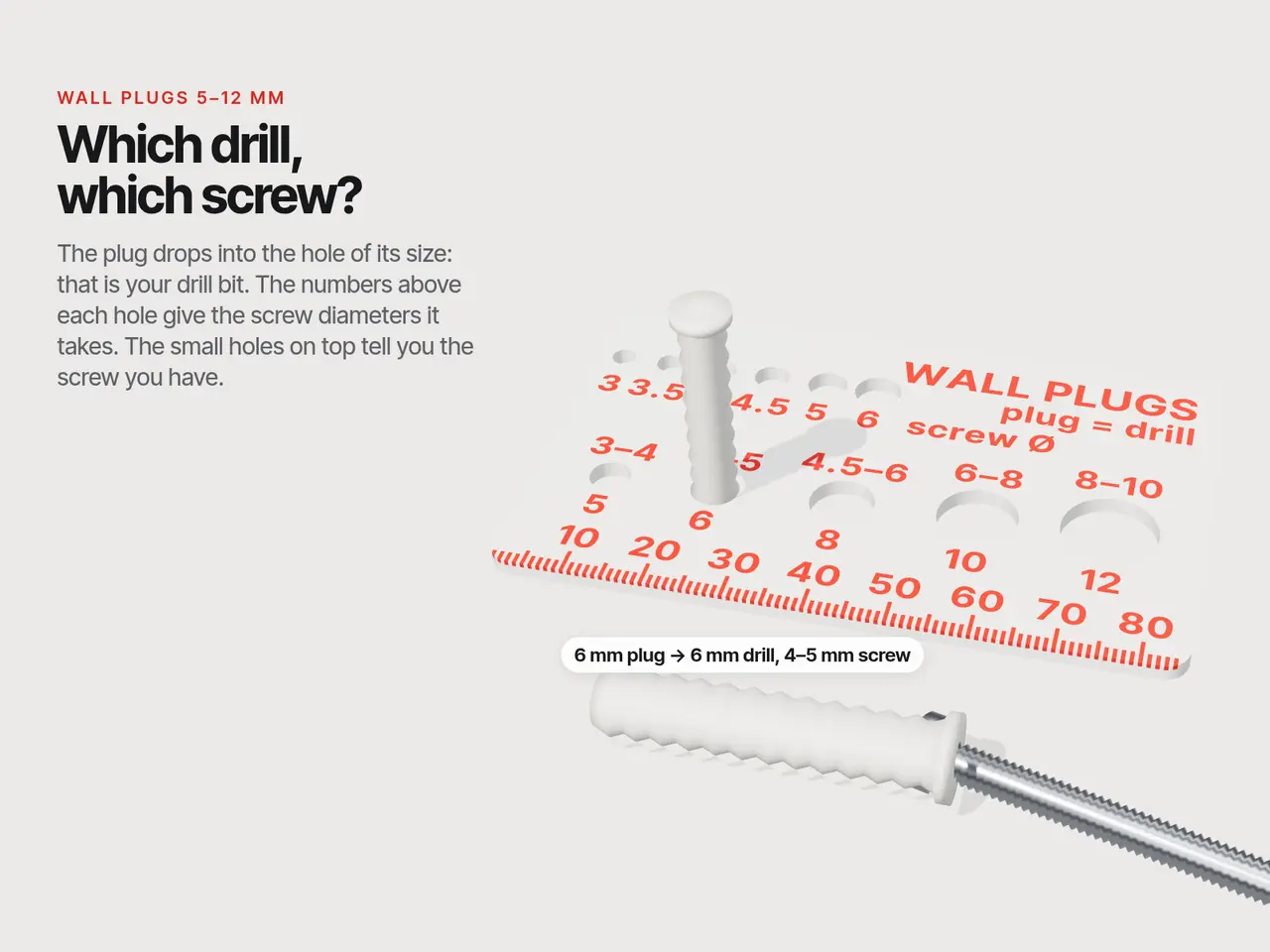
Which drill bit and which screw for this wall plug? Credit-card gauge for 5–12 mm plugs. Two colours, no supports.
Licencia
Uso comercial permitidoPuedes imprimirlo, modificarlo y venderlo dando crédito al autor.
Al descargar aceptas respetar la licencia y dar crédito a tatutsa888.
Archivos (4)
- Categoría
- Herramientas
- Formatos
- 3MF, STL
- Descargas
- 2
- Publicado
Sobre este modelo
You found a bag of loose wall plugs. Which drill bit do they need, and which screws go with them? This credit-card gauge answers both. How to use it - The bottom row of holes (5, 6, 8, 10 and 12 mm) is for the plug: it goes into the hole of its size. That number is also your drill bit.
- Above each hole: the screw diameters that plug takes (from the usual nylon plug charts: 5 → 3–4, 6 → 4–5, 8 → 4.5–6, 10 → 6–8, 12 → 8–10 mm).
- The top row (3 to 6 mm, "screw Ø") tells you the screw you have: it passes through the smallest hole it fits.
- The millimetre ruler along the bottom edge measures the screw length. Butt the head against the left edge.
- Always check the plug maker's chart for your wall: hollow bricks, plasterboard and concrete can call for different plugs.
Print settings - PLA, 0.2 mm layers, 2.2 mm thick, flat, marked face up, no supports, 100 % infill.
- The 3MF assigns red to slot 1 and white to slot 2 (MMU3). Red is a 0.6 mm inlay. For one colour, print carte-chevilles.stl.
Accuracy - Plug holes are 0.3 mm over nominal and screw holes 0.25 mm over; printed holes come out a little smaller. First prints are being tested and I will adjust here if needed.
Part of the same series as the Wallet Workshop Gauges: same size, same ruler. Designed with AI assistance (parametric Python script, manifold3d). En français Carte jauge pour chevilles, format carte bancaire. La cheville entre dans le trou de sa taille (5 à 12 mm) : c'est aussi le diamètre du foret. Au-dessus de chaque trou, les diamètres de vis qui vont avec. En haut, des trous de 3 à 6 mm pour connaître le diamètre de sa vis. Marquages rouges incrustés, 3MF prêt pour la MMU3, sans supports.
Descripción original del autor, publicada en Printables.