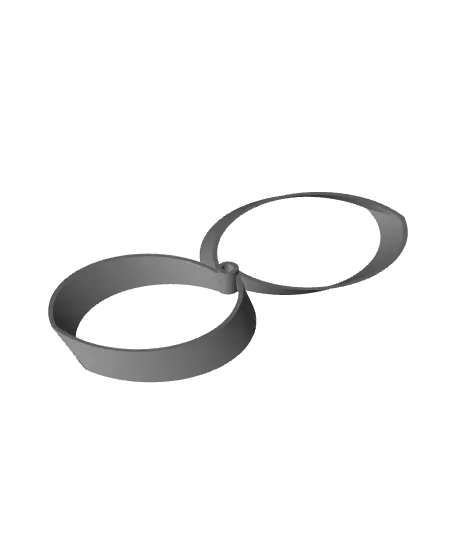
Toroidal Drone
https://linktr.ee/blake3dcake
Thangs entrega los archivos a usuarios con cuenta gratuita
Licencia
Solo uso personalSin licencia indicada
El autor no indicó una licencia: todos los derechos le pertenecen. Úsalo solo para imprimir en casa y consulta al autor para cualquier otro uso.
Al descargar aceptas respetar la licencia y dar crédito a Blake H.
Archivos (5)
- Frame.obj OBJ · 951 KB
- FrameReinforced.obj OBJ · 995 KB
- Housing.obj OBJ · 1,0 MB
- LProp.obj OBJ · 967 KB
- RProp.obj OBJ · 967 KB
- Categoría
- Tecnología
- Formatos
- OBJ
- Descargas
- 87
- Publicado
Sobre este modelo
https://linktr.ee/blake3dcake
I gutted this $45 Amazon drone https://amzn.to/3R1EyMj to create this unique toroidal drone!
The toroidal propellers make it much quieter and losing the frame cuts the weight by about 33%.
I included the .f3d file so the props or frame can be potentially adapted to another drone.
A toroidal propeller is a type of propeller that is ring-shaped. Toroid propellers are significantly quieter, and are claimed to be more efficient than traditional propellers both in air and water. Wiki - https://en.wikipedia.org/wiki/Toroidal_propeller
Disclaimer: The full build is challenging. I would recommend replacing the stock propellers with toroidal propellers before deciding if you want to go through with the entire build.
Settings - I printed my propellers in HIPS (high impact polystyrene) but polypropylene, PETG, or PLA should probably still work (although probably heavier and less impact resistant). Be sure to remember that 2 of the motors spin in opposite directions (LProp and RProp are mirrored to account for this).
I printed the frame and housings in PAHT-CF (high temperature nylon carbon fiber) but again, other materials should probably still work. I included a reinforced version of the frame in case the frame is not rigid enough when printing with other materials.
The trickiest part of the full build is due to the fact that the motors on the drone are not direct drive. This means that the plain bearings that fit inside of the housing must be precisely fit so the gears mesh with the motors correctly. Too tight and the props wont spin, too loose and the gears unmesh at high speeds. (I included pictures reference).
The housings are held in place with small screws salvaged from the original drone. The motors, motherboard, and battery are held down with zip ties. The battery connector and wires are held in place with rubber bands (lol). (I included pictures for reference).
Descripción original del autor, publicada en Thangs.