The DeskBot
por Pulselab en MakerWorld
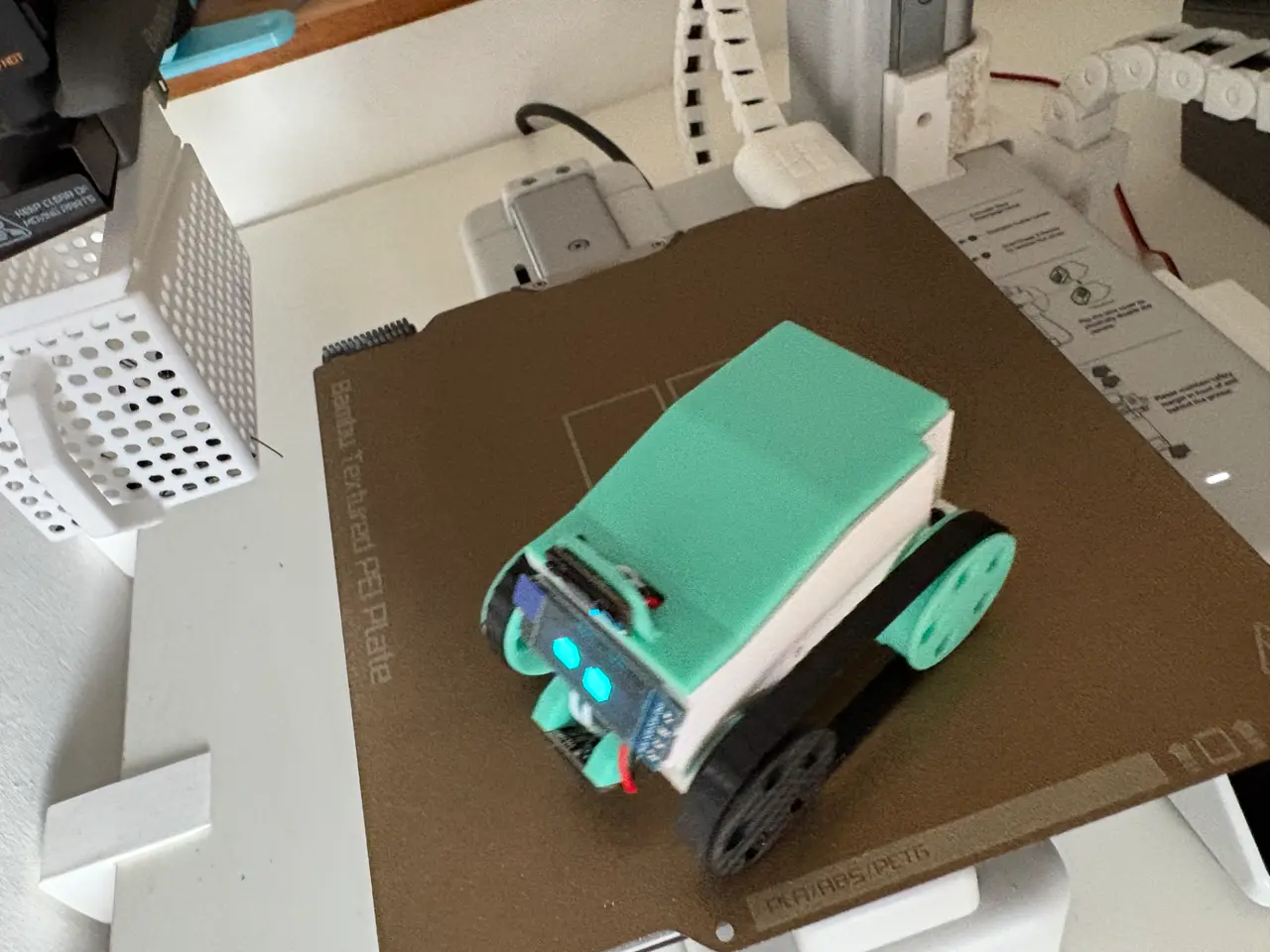
DeskBot — A Tiny Robot with Personality. DeskBot is a compact, 3D-printed tracked robot powered by an ESP32-S3. With expressive OLED eyes, autonomous roaming and wireless control, it brings together electronics, mechanics and playful behaviour in a small DIY build.
MakerWorld entrega los archivos a usuarios con cuenta gratuita
Licencia
Solo uso personalStandard Digital File License
Licencia estándar de archivos digitales: solo uso personal. No se permite compartir, revender ni subir el archivo a otros sitios, ni vender las impresiones.
Al descargar aceptas respetar la licencia y dar crédito a Pulselab.
- Categoría
- Miniaturas
- Descargas
- 0
- Publicado
Sobre este modelo
DeskBot — A Tiny Robot with Personality DeskBot is a compact, 3D-printed tracked robot powered by an ESP32-S3. With expressive OLED eyes, autonomous roaming and wireless control, it brings together electronics, mechanics and playful behaviour in a small DIY build. Originally created as a personal gift, DeskBot is an evolving project for makers who enjoy building, programming and experimenting with robotics. Features
- Expressive OLED eyes: animated expressions and eye movements that accompany the robot’s behaviour.
- Autonomous roaming: obstacle avoidance, occasional direction changes and configurable movement.
- Wireless manual control: connect to DeskBot over Wi-Fi and control it through a browser-based interface.
- Dual distance sensing: a forward-facing sensor detects obstacles, while a downward-facing sensor monitors the surface ahead.
- Configurable edge response: reverse and turn when a valid downward measurement indicates a drop.
- Movement calibration: adjust motor balance, speed, turning times and avoidance settings through the web interface.
- Behaviour profiles: different roaming styles with adjustable movement and pauses.
- Decision log: inspect recent robot actions to help understand and tune its behaviour.
- Rechargeable power: a single-cell LiPo battery with USB-C charging.
Future Development: Simulation-Based Learning A major planned direction for DeskBot is machine learning through simulation. The goal is to train and evaluate movement and obstacle-avoidance policies in a virtual environment before testing them on the physical robot. The current firmware uses rule-based control and manual calibration. Simulation-trained behaviour is a future development goal and is not included in the current release. Building and Testing This project requires soldering, mechanical assembly, firmware installation and calibration. The described functions require compatible DeskBot firmware. Surface detection does not guarantee protection against falls. A single downward-facing sensor cannot monitor every part of the robot, particularly during reversing and turning. Start testing on the floor and supervise operation on raised surfaces. The prototype’s power system is still under investigation for intermittent resets. Check that your battery, protection circuit and voltage converter can handle the combined peak current of the motors and electronics. Parts List Electronics QuantityComponentSpecification / notes 1ESP32-S3 development boardN16R8 version: 16 MB flash and 8 MB PSRAM; match the printed mount 2GA12-N20 geared DC motors6 V, 200 RPM version used in this build 2Bidirectional mini brushed ESCs3–6 V, 1 A nominal rating, RC-style 1000–2000 µs control; forward and reverse required 2VL53L0X ToF sensor modulesOne forward-facing and one downward-facing 1OLED display0.91-inch, 128 × 32 pixels, I²C 1LiPo battery1S, 3.7 V nominal, 2000 mAh, 103450 format 1USB-C charging and boost moduleJ5019-style module used in the prototype, adjusted to 5 V; full-system reliability is not yet confirmed 1Battery protection circuitSuitable 1S protection, unless already integrated into the battery 1Electrolytic capacitor330 µF, rated at least 10 V, across the 5 V supply As neededWires and connectorsSuitable for the motor current and available space
Mechanical Components QuantityComponentNotes 2625 bearings5 mm bore × 16 mm outer diameter × 5 mm width 1 set3D-printed body and chassis partsMatch the supplied model 1 setWheels and track componentsMatch the supplied design As neededAxles, screws and fastenersMatch the printed parts
Check component dimensions before printing. Modules with the same product name can differ in board size, mounting holes and connector placement. Designed by PulseLab.
Descripción original del autor, publicada en MakerWorld.