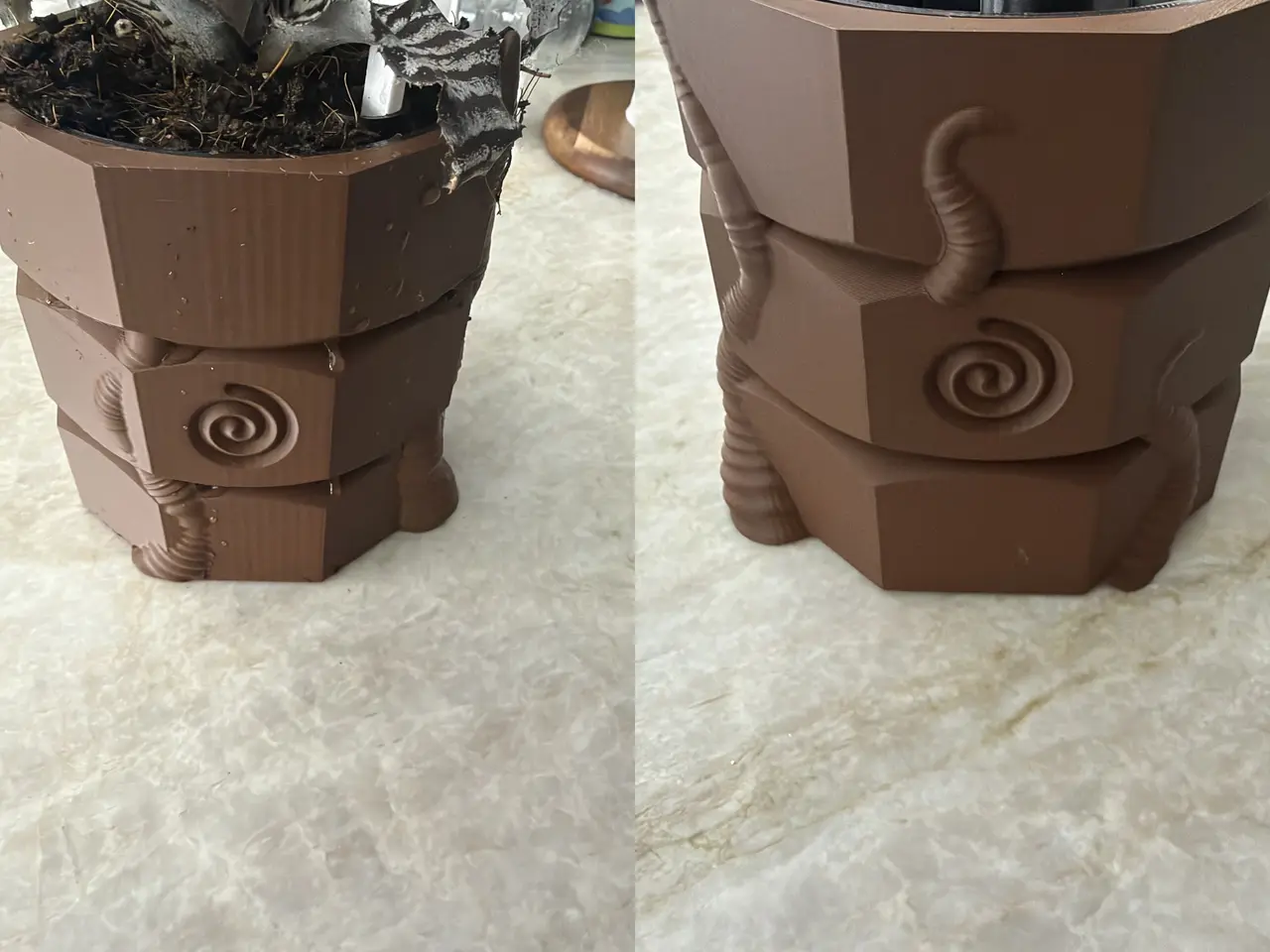
R'lyeh Stone Self-Watering Planter (Cthulhu)
por Bill Mathews en Thingiverse
Designed, printed, photographed and used by a human. The CAD code and the documentation were written with AI. A self-watering planter for small indoor plants (about a 10 cm nursery pot). The outside is a nine-sided block of sunken R'lyeh stone with carved spiral glyphs and Cthulhu's tentacles...
Licencia
Solo uso personalCC BY-NC-SA 4.0 — Atribución, no comercial, compartir igual
Uso personal dando crédito; sin fines comerciales y las modificaciones con la misma licencia.
Al descargar aceptas respetar la licencia y dar crédito a Bill Mathews.
Archivos (6)
- Categoría
- Hogar
- Formatos
- STL, ZIP
- Descargas
- 0
- Publicado
Sobre este modelo
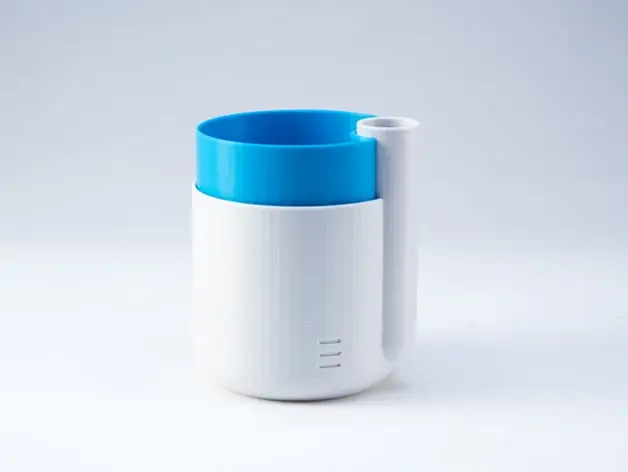
Designed, printed, photographed and used by a human. The CAD code and the documentation were written with AI. A self-watering planter for small indoor plants (about a 10 cm nursery pot). The outside is a nine-sided block of sunken R'lyeh stone with carved spiral glyphs and Cthulhu's tentacles climbing it. Two of them reach up over the rim. It's two pieces and a dipstick, with no glue, screws or wick: - The shell is the water reservoir, about 190 ml up to the full line. - The pot holds the soil and sits inside the shell, hanging from its lip. Its floor is a steep cone that funnels down into a slotted wicking well. Soil packed into the well stands in the water and draws it up into the pot, so there's no cotton wick to rot or dry out. - The fill tube at the pot's edge drops straight through to the reservoir. You water through it, and the dipstick stands in it and shows the level. - Air slots in the pot's upper wall let the roots breathe. The gap behind them vents out through the fill tube and through notches hidden under the pot's lip.
images/artwork.png is a cutaway showing how the parts fit together. The shell is about 124 × 117 mm and 116 mm to the rim (136 mm to the tentacle tips). The pot's soil opening is 88 mm across. Files filematerial / colorwhat it is planter_shell.stlPLA or PETG, stone colorthe reservoir and the stone planter_pot.stlPETG, any colorthe soil pot planter_dipstick.stlanythingthe water-level dipstick planter_shell_mark_silver.stlsilver PLA (optional)the designer's mark under the shell: the B planter_shell_mark_red.stlred PLA (optional)the mark's x Printing Three separate prints. 0.2 mm layers, no supports, no brim for all of them. Every overhang is designed to print at 0.2 mm (46° or less); taller layers will start to droop under the tentacles. The shell - Upright, open side up. That's how the STL is oriented. - Set wall loops to 5. This is the one setting that matters. The walls are 2 mm, so 5 loops make them solid perimeter with no infill, and that's what keeps the water in. With the default 2 or 3 loops, sparse infill inside the wall can let water seep through. - The floor is 8 layers, so the default 3 bottom and 5 top shells already make it solid. - PLA is fine indoors and out of the sun. Use PETG anywhere warmer. - The mark is optional. The shell has a shallow pocket under its base. To fill it, load the two mark STLs as parts of the same object as the shell (they're already positioned) and give them silver and red. They only fuse to a PLA shell. On PETG, or in one color, leave them out and the pocket prints as an engraved mark. - Test it before you plant. Fill the shell with water and leave it on a paper towel for an hour.
The pot - PETG, because it's damp all the time. - Upright, standing on its four fins. The fins widen its footprint, because the pot is tall and its well is small. - Default walls are fine.
The dipstick Lies flat. Any material. The three notches mark full, half, and time to refill. Using it - Drop the pot into the shell. Its lip settles on the shell's seat. - Soil goes in the pot only. Press soil firmly down into the well at the bottom first, since that's the wick, then fill and plant as usual. The shell holds only water. - Water the plant from the top once, to settle the soil and wet the wick. - From then on, water down the fill tube. Lift the dipstick out, pour, and dip it to check. The water is full when it reaches the top notch, the top of the well. Don't overfill. Above the full line the water reaches the bottom of the soil cone, and the soil stays soggy. - Refill when the water is down to the lowest notch. How fast that happens depends on the plant and the room, so check the dipstick every few days at first.
Remixing - The planter is planter.scad. Pot size, taper, cone angle, well, slots, fill tube and shell clearances are parameters at the top. The model asserts what it can't show: that the cone and lip stay inside the overhang limit, that the fill tube misses the well, that the dipstick fits the tube, and that the carving leaves enough wall to hold water. - The tentacles are generated by tentacles.py (Python with numpy), which writes tentacles.scad. Each tentacle is a list of control points on the stone, with its thickness and how its end curls or rises. The script sinks each tentacle into the stone wherever its underside would overhang too far, and checks every point. - Your own shell: keep shell_cavity() and the vents, and put any outside you like around them. The pot, the dipstick and the water line come from the same parameters, so they stay matched.
./build.sh regenerates everything. It needs Python 3 and OpenSCAD; the first run makes a .venv/ with numpy, manifold3d and shapely. clean_mesh.py then collapses sliver edges along the tentacles. They're harmless, but some mesh checkers flag them. The sources keep their folder layout, because planter.scad finds the mark library at ../Makers Mark/mark.scad. Keep the two folders side by side. What's in the download: the STLs and the OpenSCAD sources. The model sites don't accept scripts, so the Python and shell tooling named above isn't included. The .scad files, including the generated tentacles.scad, open and render in OpenSCAD on their own. License CC BY-NC-SA 4.0, see LICENSE. The BX mark under the shell is the designer's signature and isn't covered by it. Remixes must not reuse it. Cthulhu and R'lyeh come from H. P. Lovecraft's The Call of Cthulhu (1928), which is in the public domain in the US. This is an original design, not affiliated with or endorsed by any Lovecraft estate, publisher or game licensee.
Descripción original del autor, publicada en Thingiverse.