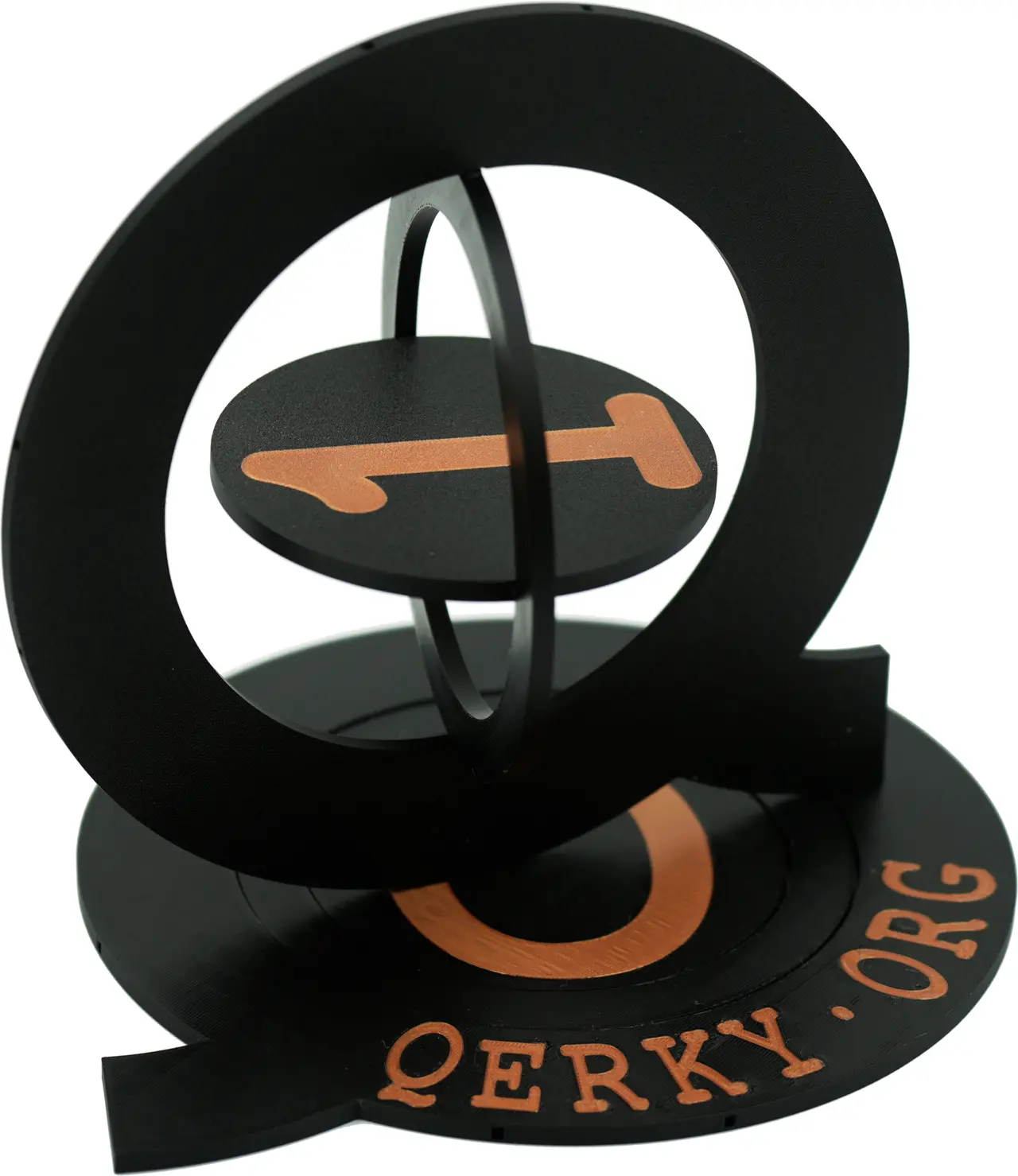
Qubit Spinner Classroom Model
por ProfHankD en Printables
This is a Bloch sphere representation of a Quantum Bit (Qubit) designed for use as a classroom model
Licencia
Uso comercial permitidoPuedes imprimirlo, modificarlo y venderlo dando crédito al autor.
Al descargar aceptas respetar la licencia y dar crédito a ProfHankD.
Archivos (5)
- Categoría
- Educación
- Formatos
- STL
- Descargas
- 0
- Publicado
Sobre este modelo
This is a Bloch sphere representation of a Qubit -- a Quantum Bit. It prints assembled in under 3 hours on a typical modern printer, but is 210x210x5mm, large enough to be clearly visible to audience members when lecturing and manipulating the theta and phi angles by hand. Alternatively, it can be hung using fishing line or string via semi-circular cavities that allow the line to be looped through the top, bottom, left, or right of the Qubit with 50mm distance between line entry and exit points; this makes it easy to hang one or more so that they apparently float in a planar array. Such a planar array makes it easy to use multiple Qubits to manually work through operations on entangled superpositions. Technically, the Bloch sphere notation labels the top of the sphere with 0 and the bottom with -1 because the value is encoded as a probability amplitude using complex numbers that must be squared to produce a probability. In other words, the Bloch sphere labels usually follow Ernst Ising's description of the energy of a system of spins, and there is a "pointer" version of this design for those who think of 0 at the top and -1 at the bottom. However, I find it more natural to think of this two-dimensional probability density function in terms of how close a 0 or 1 marking is to pointing up. After all, the probability of 0 vs. 1 is strictly a function of theta; phi, the phase, is irrelevant. To be precise, theta is the rotation of the center part about the X axis of the middle ring, and phi is the rotation about the Z axis of the outer Q shape, but it is convenient to keep the Q shape in a fixed orientation and rotate the pair of inner parts to reflect phi. Most of our earlier "Q-bit" models simplified things by not representing the phase at all, but phase is important when explaining some quantum operators. In picking between the pointer and 0/1 versions of this design, note that the pointer version has been designed to have virtually identical volumes above and below the centerline so that the arrow can balance, but friction at the pivot point is very low, so even minor slicer variations may result in the arrow version rotating into a preferred orientation. Empirically, that doesn't seem to happen with the 0/1 core. Either version of this design can be printed assembled on most consumer 3D printers without any alterations. If your printer can handle more than one color, make the text in a contrasting color. If not, print only the body, and you can paint in the embossed text using an acrylic paint pen. In any case, don't mix the pointer and 0/1 files; the ones ending in pbody and ptext implement a pointer, the others implement a 0/1 labeled core. Tolerancing is tuned for FDM printing PLA using a nozzle of approximately 0.4mm and an extrusion layer height around 0.2mm. There is also a rather minimal stand to hold the Qubit upright, but they are really designed to be either hand-held or hanging. This is one of many 3D-printable Qubit designs created by Professor Henry (Hank) Dietz and his Aggregate.Org research group, which is based in the Electrical and Computer Engineering Department of the University of Kentucky. However, this version is specifically intended to be distributed by QERKY.ORG to promote Quantum Education and Research in KentuckY. That is why QERKY.ORG is discreetly printed on the back of the surrounding Q.
Descripción original del autor, publicada en Printables.