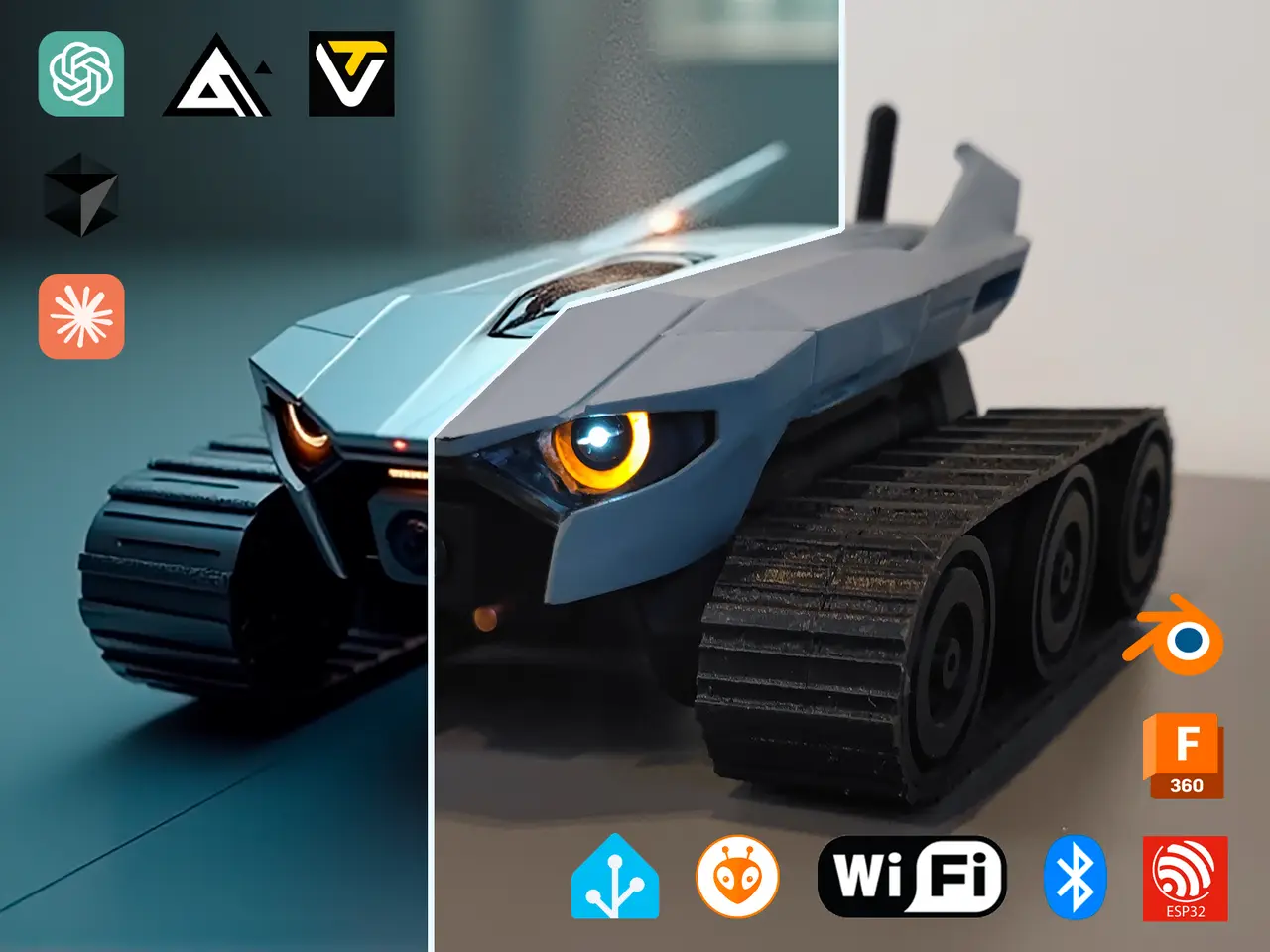
Project Caretaker - ESP32CAM remote controled robot
por Anton Filatov en Thingiverse
Project Caretaker is a remotely controlled robot based on esp32-cam and a custom 3D-printed platform. Main features: WiFi and BT control; Home Assistant integration; Powerful LED eyes control; 2 control options - joystick and slider; Adaptive web interface for control. All models have information...
Licencia
Solo uso personalCC BY-NC 4.0 — Atribución, no comercial
Puedes imprimirlo y modificarlo para uso personal dando crédito. No se permite vender las impresiones.
Al descargar aceptas respetar la licencia y dar crédito a Anton Filatov.
Archivos (19)
- arm_x3_+_x3_mirrored.step STEP · 174 KB
- base-platform.step STEP · 331 KB
- camera.step STEP · 51 KB
- caretaker.f3z F3Z · 35,8 MB
- caretaker-bottom.stl STL · 2,9 MB
- caretaker-top.stl STL · 1,8 MB
- eye-inner_x2_mirrored.step STEP · 12 KB
- eye-outer_x2_mirrored.step STEP · 12 KB
- track-thin_x2_TPU.step STEP · 1,6 MB
- wheel-inner_x6.step STEP · 61 KB
- wheel-outer-inn_x6.step STEP · 20 KB
- wheel-outer-out_x6.step STEP · 44 KB
- charger-backbox.step STEP · 78 KB
- charger-backplate1.step STEP · 108 KB
- charger-backplate-2.step STEP · 108 KB
- charger-box.step STEP · 86 KB
- charger-plate-left.stl STL · 20 KB
- charger-plate-right.stl STL · 20 KB
- track_0.8mm.step STEP · 1,6 MB
- Categoría
- Tecnología
- Formatos
- STEP, F3Z, STL
- Descargas
- 2,551
- Publicado
Sobre este modelo
Project Caretaker is a remotely controlled robot based on esp32-cam and a custom 3D-printed platform. Main features: WiFi and BT control; Home Assistant integration; Powerful LED eyes control; 2 control options - joystick and slider; Adaptive web interface for control. All models have information about printing - quantity and mirroring. Robot Esp32cam - the main brain - can also be found under the name AI thinker. Wide-angle camera with extended cable - the viewing angle is not as critical as the cable length. With a shorter cable, it would be more difficult to design an aesthetically pleasing case. Wifi antenna with connector - often comes with the board. 3 li-ion batteries, connected in series (12.6v) with holders. 2 dc-dc step-down converters (12v and 5v). 2-channel motor driver - L298N, L293D or similar - I use L293D due to smaller board dimensions, although I modeled for L298N. 2 GA12-N20 (12V) motors with a gear ratio of 150 (you can take 200 - it will be faster). 12 bearings 6803 (two per wheel). BMS charging board (if you plan to charge in the device). Power switch for battery supply. Mosfet IRLML0030 + 1 kΩ resistor for LED control. LEDs and resistors - to taste. All other parts are made of plastic, printed on a printer (including tracks). Charging station Power supply 12.6V 2A. Corresponding power connector for the case. Volt-ampere meter (preferably less powerful up to 5A, otherwise it will not show small current). Contact pair - in my case, copper plates and rods. A pair of springs for better contact during charging. All opensource here - https://github.com/positron48/robot Blogposts about project - https://positroid.tech/en/post/caretaker-part-1 Article in russian - https://habr.com/ru/articles/898936/ If you like this project, consider giving it a star on GitHub — it helps a lot! Youtube demo - https://www.youtube.com/watch?v=m7IXScezX9o More exclusive content and real-time updates in my Telegram channel - https://t.me/positroidlive
Descripción original del autor, publicada en Thingiverse.