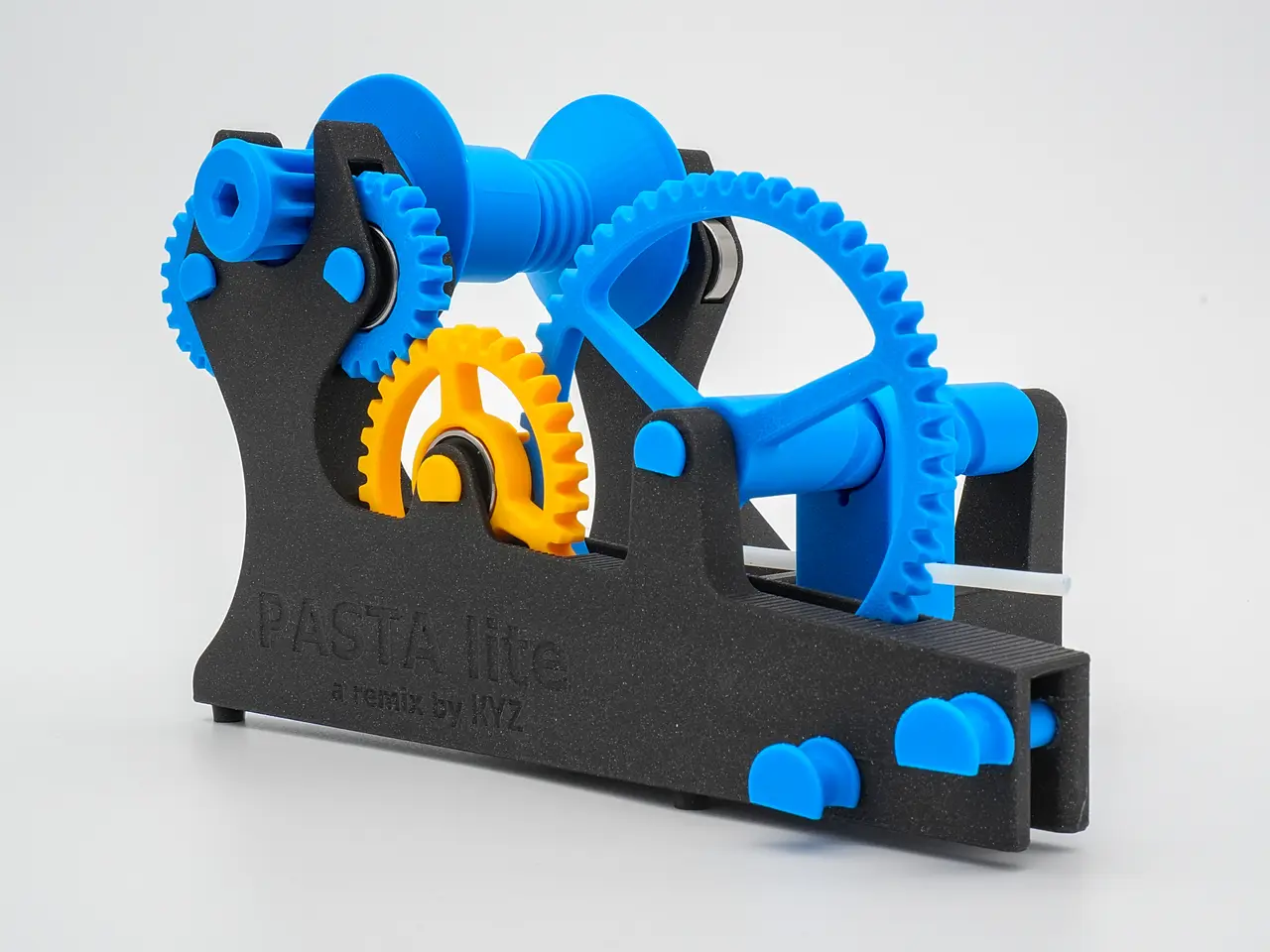
PASTA lite Receiver - a Pastamatic Remix
por KYZ Design en Printables
A compact Pastamatic overhaul.
Licencia
Solo uso personalCC BY-NC-SA 4.0 — Atribución, no comercial, compartir igual
Uso personal dando crédito; sin fines comerciales y las modificaciones con la misma licencia.
Al descargar aceptas respetar la licencia y dar crédito a KYZ Design.
Archivos (19)
- KYZ PASTA lite - Receiver Body.stl STL · 1,1 MB
- KYZ PASTA lite - Receiver Body A1M L.stl STL · 1,2 MB
- KYZ PASTA lite - Receiver Body A1M R.stl STL · 724 KB
- KYZ PASTA lite - Spindle Front.stl STL · 3,1 MB
- KYZ PASTA lite - Spindle Back.stl STL · 594 KB
- KYZ PASTA lite - Lead Screw.stl STL · 1,5 MB
- KYZ PASTA lite - Guide Housing.stl STL · 883 KB
- KYZ PASTA lite - Guide Pin.stl STL · 405 KB
- KYZ PASTA lite - Pin Long.stl STL · 917 KB
- KYZ PASTA lite - Pin Long Flat.stl STL · 402 KB
- KYZ PASTA lite - Pin Short.stl STL · 1,1 MB
- KYZ PASTA lite - Pin Short Flat.stl STL · 507 KB
- KYZ PASTA lite - Idler Fully Printed v2.stl STL · 744 KB
- KYZ PASTA lite - Idler 608.stl STL · 498 KB
- KYZ PASTA lite - Reducer Gear Fully Printed V2.stl STL · 1,7 MB
- KYZ PASTA lite - Reducer Gear V2 608.stl STL · 1,4 MB
- KYZ PASTA lite - 608 Bearing Fully Printed.stl STL · 539 KB
- KYZ PASTA lite Receiver v1.0 - 2-Tone 3 Wall.3mf 3MF · 3,5 MB
- KYZ PASTA lite Receiver v1.0A1M - 2-Tone 3 Wall.3mf 3MF · 4,0 MB
- Categoría
- Para tu impresora
- Formatos
- STL, 3MF
- Descargas
- 4,680
- Publicado
Sobre este modelo
Compatibility Use v1.0 or v1.0A1M receiver: - As a stand-alone unit in conjunction with another stand-alone spool roller/stand/holder - OR with Donor Spool Roller v0.3 or newer - OR with Donor Spool Spinner v0.5 or newer
v0.5 and later receiver versions are NOT compatible with Donor Spool Spinner v0.4 and earlier. As I made the receiver more compact and lowered the centre of gravity of the receiver spool, the filament path needed to be closer to the ground which necessitated a change in the orientation of the donor spool. The lead screw position changed to accommodate the filament path, which collided with the interfacing dovetail joint, etc. If you've printed the v0.3 receiver and it's working well for you, I would stay with it! If you already made the v0.3 (or earlier) receiver, you can use it with Donor Spool Spinner v0.4. Gallery A-10 Warthog @PiTon Bumblebee @mike.bosch Broccoli Lab @delikid
Tacti-cool @rkc613 LG @MotoX501 Hospital Grade @OAG_163
Anodised @DavidDerbyshire Aliens (Toy Story) @steve.lockley Venom @Happy1900
Storm Trooper @user_1750046560 Vampire's Garden @pnwnerd Mission Ready @rob_frye
Royal Rhubarb @BeePo3D Afterburner @vrplanet_26135 (PETG print) Pistachio Mill @chippicous (3kg donor spool)
Panda @Tarik77 Let it go, let it go~ @rbcmptrmn Act IV (Diablo III) @user_3108603171
Background I've been enjoying the original Pastamatic for a year now but there were many things I wanted to change. I know that the Pastamatic isn't intended to be a "project" but when I needed to print a second one, on boy did I make it a project… I hope the reduction in global frustration and filament usage was worth the effort! Main differences to the original Pastamatic: - Smaller footprint with reduced height for easier storage - ~41% filament reduction from ~650g to ~380g (with similar print settings and using the donor spool “spinner” variant) - ~46% print time reduction from ~22 hours to ~12 hours (with similar print settings and using the donor spool “spinner” variant) - 100% less purchased bearings from 14 608zz bearings to 0 (with option to upgrade) - Easier printing with all tall objects having a larger bed contact area - Reworked clearances and reduction of inertial mass of moving parts for significantly lower turning resistance of gears (no more “hopping" of the spindle, no spindle clips needed) - Rigid frame for ease of use and quality feel - 2-piece frame variant printable on a 180x180 bed (A1 Mini)
And as with the original Pastamatic: - NO fasteners - NO heat-set inserts - No supports and easy overhangs on all printed parts - ~5 minute assembly - ~2 minute spool transfer - Designed to be a tool you just print and use when you need it, not a massive side quest (unless you're me)
Materials - PLA works great- Avoid materials with reduced layer adhesion such as PLA-CF, silk PLA and “ABS+”
- TPE or soft TPU for the optional feet (just 2-3 grams)
Print settings - If this is “just a tool”- 0.20mm Standard with - “Spindle front” layer height reduced to 0.18 to reduce friction with gears (less layer locking) - 15% “support cubic” infill
- If you want something more substantial and quieter- 0.20mm, 3+ walls, 4+ bottom, 5+ top - “Spindle front” layer height reduced to 0.18 to reduce friction with gears (less layer locking) - 15% “grid” infill or other non “support” infill (this helps with noise as the parts will sound less hollow) - 60mm/s outer wall speed, 80mm/s top wall speed
- If the printed bearings are seized, reduce the layer height for these parts or check the Bambu Lab Wiki - Flow Rate Calibration or the equivalent for your printer.
Other materials needed - Approximately 100mm length of of PTFE tubing (4mm OD 2mm or 2.5mm ID) - An electric screwdriver or drill driver with a ¼ inch bit- this does not have to be a ¼ inch allen key, using any ¼ inch drive bit front-to-back will work as long as it's long enough for the driver to grip
Assembly Optional steel bearing upgrade The idler gears and reducer gear can be upgraded with 608zz bearing versions for quieter operation and a more premium feel. See print profile "608 and Flat Pin Set".
How to use CAUTION USE EYE PROTECTION BE AWARE OF OTHER PEOPLE AND PETS AROUND YOU Frequently asked questions - Why do people need respoolers?- Some spools don't fit in the AMS because- They are slightly bigger as they weren't designed for the AMS (this is getting less and less common as filament manufacturers design their spools to fit in the AMS). - Some spools are designed to fit but the filament is wound too tightly and the rims flare out, rub in the AMS (and cause retraction issues). - They're bulk spools (2kg, 5kg, etc)
- You may want to redistribute a single filament roll onto multiple spools to use on multiple printers instead of buying more of the same - especially if they are accent colours or more exotic materials. - You may have cardboard spools and- The edge is uncoated, leaving cardboard dust everywhere in the AMS - The spool is deformed from improper storage - You have retraction issues from lack of friction between the cardboard edge and AMS rollers (adding weight with a desiccant holder is another way to fix this)
- You may drop the spool and damage it - You have sample spools or small spools (such as 250g spools) and you don't want to make AMS adapters - Your filament broke free and it's entropying on the floor - You melt your printed spool in the filament dryer - You are splicing left-overs to make a decently sized roll - You may have respooled on a different respooler and it's just not right - u/kdegraaf: it's pleasing to certain kinds of brains to have one's entire library be on one consistent size/brand of reusable spool - u/jrbless: I tried putting the refill into two different spools and it just wouldn't lock because the refill (as packaged) was just slightly too thick for it to work, so had to respool to get it working
- Do you need to double re-spool?- Filaments have have a natural curve which is larger outside of the spool and smaller inside of the spool. Re-spooling once forces the larger curve to be smaller and visa versa. Re-spooling twice reverses this again, and the filament is under less stress when on the spool. Some users say they need to do this with their filament. This is probably more helpful for more brittle filaments (such as PLA-CF, old PLA or uncooked pasta) and much less important for more ductile filaments (such as PETG). - Alternative to double re-spooling would be to put it into a filament dryer - warming up the filament will soften the filament somewhat, allow more creep to happen, and take on the new shape.
- The filament angle changes 90 degrees when re-spooling with the PASTA lite because the spools are at a right angle. Is this a problem?- There is a fair bit of distance between the donor spool and receiver spool so the filament has plenty of distance to make the twist. Nevertheless, this could be a problem for the same reason as above (please report back if you have issues!). I do not currently know how much of a problem this would be. Again, this is probably more of an issue for more brittle filaments (such as PLA-CF or old PLA) and much less of a factor for more ductile filaments (such as PETG). - Putting the filament it into a filament dryer will help for the same reasons as above. - A frame extension to put the two spools farther away would alleviate some twist issues as there will be more distance where the filament can turn (as allow larger spools to be donor spools). This is in the works (and this side quest is rapidly becoming my main quest).
Changelog 30/12/2024 - Version 0.1 First prototype 1. Everything printed well the first try (except the bridging inside of “Spindle Front" which looked a little messy) 2. Another angle. Most parts self-released.
3. A fit issue was cleared up 4. Assembly was otherwise quick easy except the guide pin retainer fit was very tight. Test run appeared to go OK.
5. However the spool wound too tightly, leading to the rim flaring out. The Prusament spool in the previous picture didn't fit in the AMS properly for this reason, and the new spool also has the same issue. 6. Significant wear seen on the donor spool carrier.
7. Wear marks on the donor spool. Note the bumpy protrusions - these lead to significantly more friction and wear. Most other donor spools would have been fine. 8. Bottom view showing the feet and the overkill double-lap/dovetail joint between the two main pieces.
31/12/2024 - Version 0.2 1. Rollers added. The pins and rollers are very loose and will fall out easily, the gaps will need to be tightened up. 2. Spindle bridging printability improvements (v0.2 on right)
3. Spindle thread pitch reduced for a more secure lock with spool (v0.2 on right). Thread is self-tightening but can loosen when if the spool decelerates rapidly with the driver speed being reduced too quickly. 4. Pencil grooves added to be able to mark nominal position of spindle in the axial direction.
Various minor fitment and clearance changes were also made.
Test run video below. The PLA bearings are extremely noisy. 02/01/2024 - Version 0.3 Version 0.3 is posted here, the mainline PASTA lite will take a different design direction that will allow from 0.25kg to 5kg spools to work as donor spools without modification. 1. Roller and roller pin clearances reworked. Pins now have 2 flat sides and the pin slots are more rectangular so that the pins can not turn. 2. Holes added to the bottom so the rollers can be pushed out if needed.
3. The prototype was printed with 3 walls and 15% grid infill to make it quieter. It is now noticeably less “tinny” when you tap it. 4. Now that the rollers don't fall out, you can hang it on your pegboard hooks:
Descripción original del autor, publicada en Printables.