Model Airplane Propeller and bonus plan for Science Olympiad 2026-2027
por Robert Marchese en Thingiverse
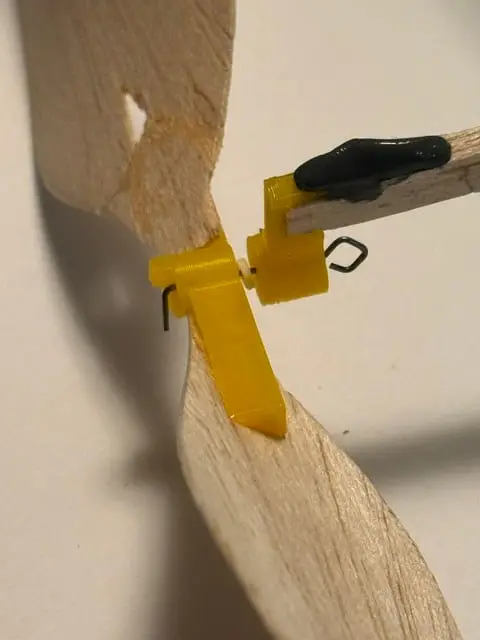
This file has parts and "tooling" to construct a propeller suitable for indoor rubber power models, such as the Science Olympiad "Wright Stuff Class C" for 2027. The three parts consist of a Prop Hanger, that attaches to the motor stick of you airplane, a thrust bearing that slides into it and...
Licencia
Uso comercial permitidoCC BY-SA 4.0 — Atribución, compartir igual
Puedes usarlo y modificarlo dando crédito; las versiones modificadas deben compartirse con la misma licencia.
Al descargar aceptas respetar la licencia y dar crédito a Robert Marchese.
Archivos (7)
- Categoría
- Para tu impresora
- Formatos
- STL, PDF, STEP
- Descargas
- 1
- Publicado
Sobre este modelo
This file has parts and "tooling" to construct a propeller suitable for indoor rubber power models, such as the Science Olympiad "Wright Stuff Class C" for 2027. The three parts consist of a Prop Hanger, that attaches to the motor stick of you airplane, a thrust bearing that slides into it and holds a small wire shaft that allows the propeller hub to spin. The blade forms were generated using a variant of one of my other "things": https://www.thingiverse.com/thing:2870790, the latest being "PropFormMkII.scad" available on my github page here: https://github.com/bobm123/PropForm/tree/master The other part is a form that sets the pitch, camber and twist of the propeller blades. For my tests, I used the bottom of the form to trace the blade pattern onto a piece of 1/32" A-grain balsa that had been soaked in warm Windex (ammonia solution) for 15 minutes. After soaking it, I blotted the blade on a paper towel, then aligned the edges with the curved part of the form and wrapped it with "Tender Tape" (a soft, elastic, cohesive wrap that sticks to itself rather than skin or balsawood) and allowed it to dry overnight. Once I had two blades prepared they were attached to the hub with CA, carefully setting the pitch angle by means of a gauge such as this one from AeroMartin https://www.thingiverse.com/thing:6765338 You could also check out this, but I do not recommend creating a built up prop (as this one is intended for) since with the 8g minimum and wing size restrictions you probably wont need to save weight here. But the basic shape could also be use to form blades. https://www.thingiverse.com/thing:7098411 Here is another mold for forming prop blades. The hub has a groove for the carbon fiber spar rod AeroMartin uses for his "flaring" style propellers https://www.thingiverse.com/thing:6720495 You will also need to bend a piece of music wire .025" music wire into a 1" prop shaft. Make a diamond hook on one end, Pass it though the bearing, add a small bead or Teflon washer, then the hub and bend it over to engage the freewheel ramp. The freewheel mechanism is actually optional, as your plan should ideally land with zero turns left. If it runs down while still in the air you should consider adjusting the size of your rubber motor. Initial tests were with a model based on the "Super Simple Airplane Build" from the National Free Flight Society Science Olympiad coaching team here: https://www.youtube.com/watch?v=Mbxba3g1hMU" My model was about 1.5 g underweight. With ballast to the 8g specification did 1:20 in the local gym on 1200 turns of 2014 vintage "Tan Super Sport" (nothing special really) cut down to .5g / foot. https://www.youtube.com/shorts/vvwj7bGC96I
Descripción original del autor, publicada en Thingiverse.