MCW Generator — Morse keyer with built-in straight key for any FM radio
por Denis Gr en Thingiverse
A battery-powered MCW keyer: a straight key built into the lid of a printed box sends 700 Hz Morse tones through a radio's microphone audio path, with PTT, sidetone, four message keys and a hinged cover. Video: https://www.youtube.com/shorts/aYVKpifshzY The MCW Generator sends Morse code as an...
Licencia
Solo uso personalCC BY-NC 4.0 — Atribución, no comercial
Puedes imprimirlo y modificarlo para uso personal dando crédito. No se permite vender las impresiones.
Al descargar aceptas respetar la licencia y dar crédito a Denis Gr.
Archivos (13)
- keyer-base.stl STL · 949 KB
- keyer-lid.stl STL · 843 KB
- keyer-labels.stl STL · 312 KB
- keyer-cover.stl STL · 571 KB
- key-lever.stl STL · 714 KB
- key-knob-tall.stl STL · 619 KB
- key-magnet-mount.stl STL · 595 KB
- key-spacer.stl STL · 39 KB
- keyer-lid-with-labels.3mf 3MF · 233 KB
- MCW-Generator-Bambu-project.3mf 3MF · 1,1 MB
- MCW-Generator-source.zip ZIP · 1,7 MB
- MCW-Generator-manual.pdf PDF · 192 KB
- LICENCE.txt TXT · 2 KB
- Categoría
- Tecnología
- Formatos
- STL, 3MF, ZIP, PDF, TXT
- Descargas
- 69
- Publicado
Sobre este modelo
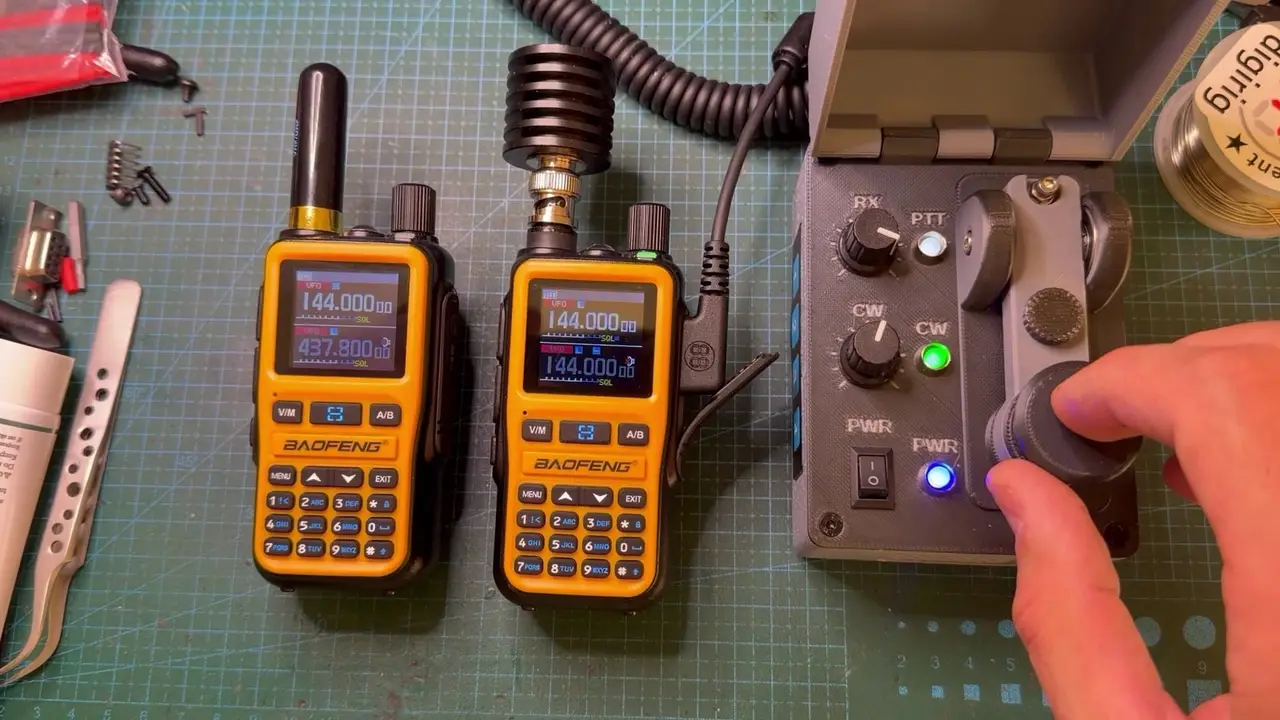
A battery-powered MCW keyer: a straight key built into the lid of a printed box sends 700 Hz Morse tones through a radio's microphone audio path, with PTT, sidetone, four message keys and a hinged cover. Video: https://www.youtube.com/shorts/aYVKpifshzY The MCW Generator sends Morse code as an audio tone through a transceiver's audio input, the way modulated CW (MCW) works on FM. It plugs into the radio with a stock Digirig audio/PTT cable and keys the radio's PTT itself. This is not a CW keyer in the usual sense. The transmitter sends an FM signal carrying a tone, not a bare carrier. The station at the other end hears it as a tone on FM and replies the same way. Features - straight key built into the lid, with adjustable gap and magnetic return - four message keys on a membrane keypad (CQ call etc., set in the firmware) - 700 Hz sine tone with 4ms rise and fall; software debounce on the key - break-in: PTT keys instantly, the transmitted tone starts 0.5 s later so the radio is settled; PTT drops 1 s after the last element - local sidetone and received audio on a built-in speaker, each with its own volume knob - LEDs for power, key down and PTT; backlit panel labels when printed in translucent filament - 3.5 mm TRRS socket wired to the Digirig pinout, so the off-the-shelf Digirig cable for your radio fits - 2×AA cells; sleeps after 15 min idle, the key or a keypad press wakes it - hinged cover held shut by magnets protects the key and knobs in a bag
Electronics: Arduino Pro Mini 3.3 V / 8 MHz, PAM8302A amplifier, one NPN transistor for PTT, and a handful of passives on a 60 × 40 mm protoboard. The full schematic, firmware, parts list and a one-page user manual are in MCW-Generator-source.zip. Closed size 80 × 110 × 75 mm. Purchased parts Electronics - 1× Arduino Pro Mini 3.3 V / 8 MHz (ATmega328P), regulator bypassed, LEDs removed — https://www.amazon.com/dp/B08LNBYLBT - 1× PAM8302A 2.5 W class-D amplifier module (remove its 1 kΩ SD pull-up) — https://www.amazon.com/dp/B0H3467G81 - 1× 2N2222 or 2N3904 NPN transistor - Resistors: 6× 1 kΩ, 3× 10 kΩ, 1× 100 kΩ - 1× 10 kΩ 3296W trimmer (TX deviation) — https://www.amazon.com/dp/B0CC91M338 - Capacitors: 1× 100 µF electrolytic, 6× 100nF - 1× 60 × 40 mm protoboard (56 × 36 mm mounting holes) - 1× 5-pin 2.54 mm header for the keypad ribbon — https://www.amazon.com/dp/B0774VBJ3J
Panel - 1× KCD11 rocker switch, 15 × 10 mm - 2× 10 kΩ potentiometer, 16 mm body, M7 bushing, with 15 mm knobs — https://www.amazon.com/dp/B0D6WB7SZJ - 1× 3.5 mm TRRS panel jack, 7 mm bushing — https://www.amazon.com/dp/B00OGLEE4C - 1× 1×4 membrane keypad, 70 × 20 mm, 5-pin ribbon — https://www.amazon.com/dp/B0C4H495MB - 1× 35 × 25 × 6.8 mm 4 Ω 3 W speaker — https://www.amazon.com/dp/B0FM3QN15Q - 3× 5 mm LEDs (blue, green, red) in 8 mm panel holders — https://www.amazon.com/dp/B08G4X5WBT - 1× set 2×AA contact plates — https://www.amazon.com/dp/B0GSTX7762 — and 2× AA cells
Key and enclosure hardware - 2× 698 bearings (8 × 19 × 6 mm) — https://www.amazon.com/dp/B0CRDZBXKH - 2× Ø10 × 3 mm magnets (key return) - 2× Ø6 × 3 mm magnets (cover latch) — https://www.amazon.com/dp/B0GVLJNTBV - 4× M3×10 countersunk screws, plain steel, not stainless (the cover magnets grip the front two) — M3 countersunk assortment: https://www.amazon.com/dp/B0GFDHNDM1 - 2× M3×35 socket head screws (cover hinge) — https://www.amazon.com/dp/B0FS1Q1QHC - 3× M3×12 socket head screws (key pivots, knob) — https://www.amazon.com/dp/B0FKM7JGQ4 - 1× M3×20 socket head screw (key stop), 5× M3 plain nuts (DIN 934) - 1× M3 washer — https://www.amazon.com/dp/B0DP6ZB4DD - 2× M3×6 set screws (speaker), 4× M2×6 self-tapping screws (board) - 1× brass round-head paper fastener, Ø10 head (fixed contact) - 1× ring solder lug, size 3.2 (moving contact) — https://www.amazon.com/dp/B0C53DX4DT - 4× Ø10 mm self-adhesive rubber feet
Cable and programming - Digirig audio/PTT cable for your radio — https://digirig.net - FTDI FT232R USB-serial adapter set to 3.3 V, for firmware upload
The full BOM with schematic references is BOM.md inside MCW-Generator-source.zip. keyer-lid-with-labels.3mf has the lid and labels already combined as one object with two parts, for any slicer. MCW-Generator-Bambu-project.3mf is the Bambu Studio project: two plates with every part placed, filaments assigned, and fuzzy skin painted on the outer walls and the cover top.
Descripción original del autor, publicada en Thingiverse.