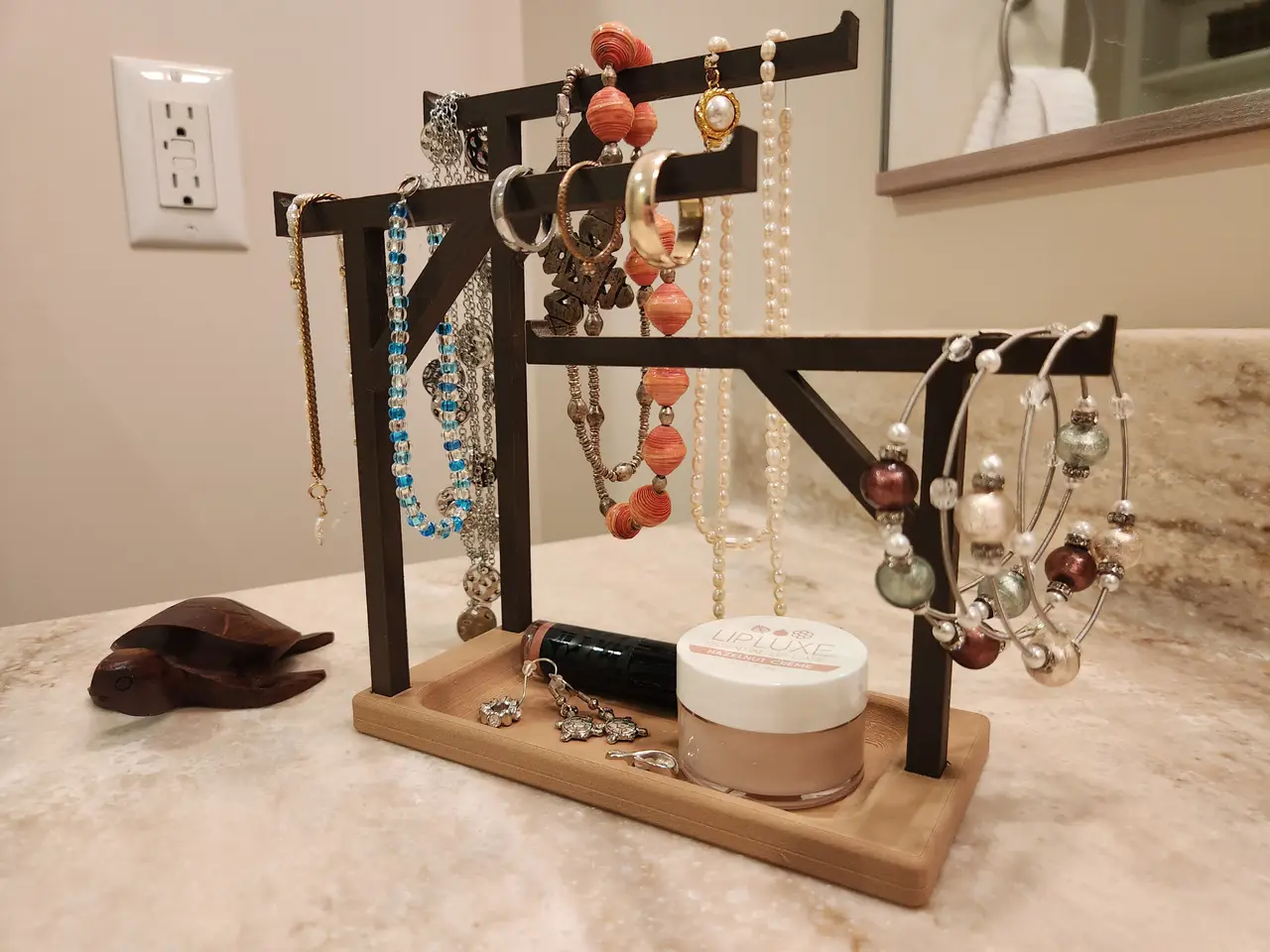
Jewelry Organizer Stand
por squinn en Printables
Provides a convenient way to showcase, hold, and organize bracelets, necklaces, rings, earrings, and more.
Licencia
Uso comercial permitidoPuedes imprimirlo, modificarlo y venderlo dando crédito al autor.
Al descargar aceptas respetar la licencia y dar crédito a squinn.
Archivos (10)
- Base.stl STL · 356 KB
- Stand - 100 mm.stl STL · 6 KB
- Stand - 135 mm.stl STL · 6 KB
- Stand - 170 mm.stl STL · 6 KB
- Stand - 205 mm.stl STL · 6 KB
- Jewelry Organizer Stand.3mf 3MF · 79 KB
- Jewelry Base_0.2mm_PLA_MINI_2h59m.gcode GCODE · 4,0 MB
- Jewelry 100 mm Stand_0.2mm_PLA_MINI_56m.gcode GCODE · 1,0 MB
- Jewelry 135 mm Stand_0.2mm_PLA_MINI_1h3m.gcode GCODE · 1,1 MB
- Jewelry 170 mm Stand_0.2mm_PLA_MINI_1h10m.gcode GCODE · 1,2 MB
- Categoría
- Moda y joyería
- Formatos
- STL, 3MF, GCODE
- Descargas
- 1,932
- Publicado
Sobre este modelo
An elegant stand to help organize and hold jewelry of different shapes and sizes. Includes a recessed tray on the bottom for smaller items such as earrings, and the three arms can then easily accommodate bracelets, necklaces, anklets, rings, etc. This has quickly become my wife's favorite model, and I hope you can enjoy as well. 😊 The one shown in the pictures was printed on my Prusa Mini and is using the three shortest stand lengths, but I've also uploaded an additional size larger for those that may prefer it and have a larger printer. No supports are required (the stands should be printed on their backs), and I'd recommend setting the “Vertical Shells → Perimeters” setting to 3 or higher in the slicer - just to give things a bit more strength. In addition to the STLs, I'm also attaching a 3MF file that includes all of the parts as well as the ‘gcode’ I used for my print. The stands are designed to simply snap into the base and have just a small amount of tolerance built into them, so they should hold tightly without requiring any glue. Depending on how your filament behaves, you may need to use a couple of taps from a hammer to get them seated the first time. Here is a zoomed-in section analysis picture of how the snap joints are modeled so that you have an idea:
Descripción original del autor, publicada en Printables.