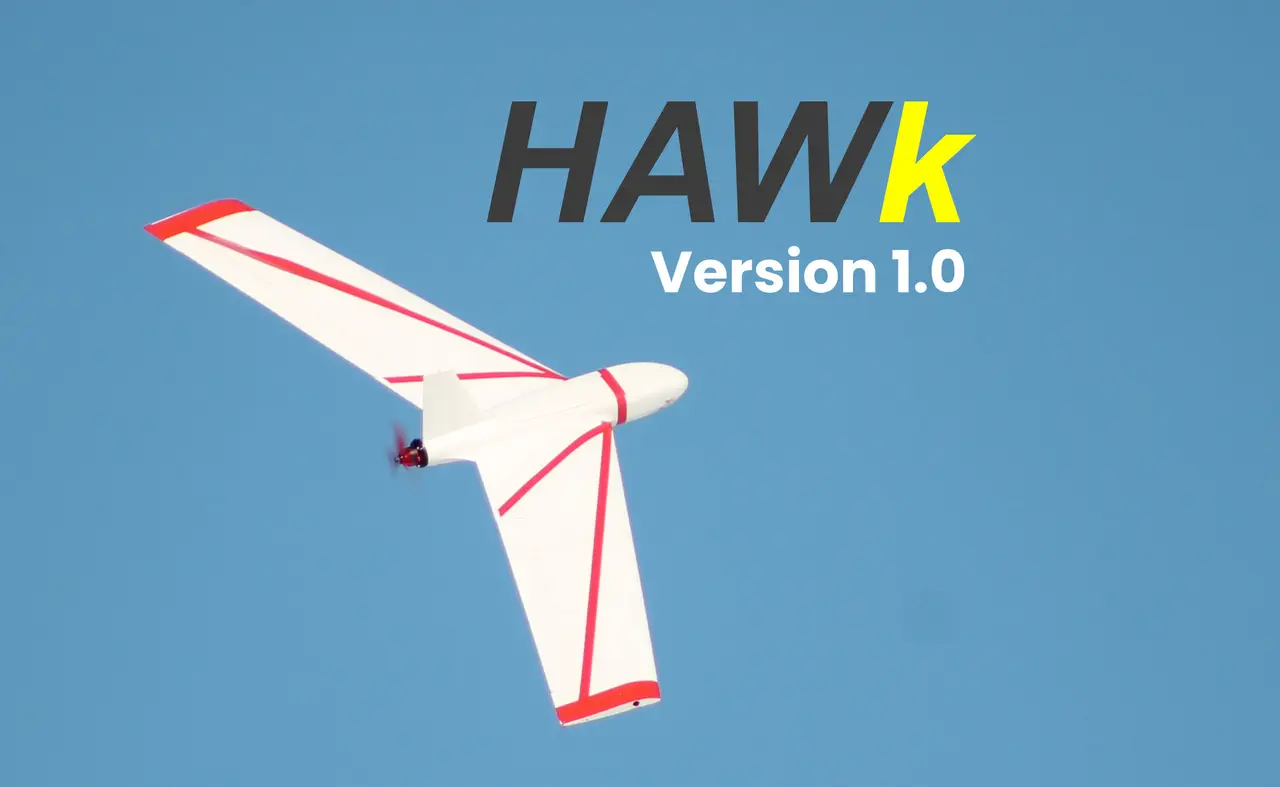
HAWk Modular RC Wing Airplane
por Neues Fliegen e.V. en Printables
A profesionally designed, well-tested flying wing with modular parts that is easy to print and fun to fly.
Licencia
Solo uso personalCC BY-NC 4.0 — Atribución, no comercial
Puedes imprimirlo y modificarlo para uso personal dando crédito. No se permite vender las impresiones.
Al descargar aceptas respetar la licencia y dar crédito a Neues Fliegen e.V..
Archivos (93)
- HAWk V1.0 - F01-A - Fuselage one-piece.stl STL · 44,9 MB
- HAWk V1.0 - F01-B1 - Fuselage segment front.stl STL · 2,0 MB
- HAWk V1.0 - F01-B2 - Fuselage segment middle.stl STL · 1,1 MB
- HAWk V1.0 - F01-B3 - Fuselage segment rear.stl STL · 19,5 MB
- HAWk V1.0 - F02 - Fuselage cover front.stl STL · 1,3 MB
- HAWk V1.0 - F03 - Fuselage cover rear.stl STL · 1,2 MB
- HAWk V1.0 - F04-A - Fuselage nose with motor mount.stl STL · 496 KB
- HAWk V1.0 - F04-B - Fuselage nose simple.stl STL · 1,1 MB
- HAWk V1.0 - W01 - Wing segment L1.stl STL · 188 KB
- HAWk V1.0 - W02 - Wing segment L2.stl STL · 208 KB
- HAWk V1.0 - W03 - Wing segment L3.stl STL · 210 KB
- HAWk V1.0 - W04 - Wing segment L4.stl STL · 237 KB
- HAWk V1.0 - W05 - Wing segment L5.stl STL · 122 KB
- HAWk V1.0 - W06 - Wing segment R1.stl STL · 188 KB
- HAWk V1.0 - W07 - Wing segment R2.stl STL · 208 KB
- HAWk V1.0 - W08 - Wing segment R3.stl STL · 210 KB
- HAWk V1.0 - W09 - Wing segment R4.stl STL · 237 KB
- HAWk V1.0 - W10 - Wing segment R5.stl STL · 122 KB
- HAWk V1.0 - E01 - Elevon segment L1.stl STL · 34 KB
- HAWk V1.0 - E02- Elevon segment L2.stl STL · 66 KB
- HAWk V1.0 - E03 - Elevon segment L3.stl STL · 40 KB
- HAWk V1.0 - E04 - Elevon segment R1.stl STL · 34 KB
- HAWk V1.0 - E05 - Elevon segment R2.stl STL · 66 KB
- HAWk V1.0.1 - E06 - Elevon segment R3.stl STL · 40 KB
- HAWk V1.0 - M01-A - Motor bracket front no holes.stl STL · 40 KB
- HAWk V1.0 - M01-B - Motor bracket front 12mm diameter M2.stl STL · 264 KB
- HAWk V1.0 - M01-C - Motor bracket front 16mm and 19mm diameter M3.stl STL · 271 KB
- HAWk V1.0 - M02 - Motor mount rear receiver.stl STL · 167 KB
- HAWk V1.0 - M03-A - Motor bracket rear no holes.stl STL · 42 KB
- HAWk V1.0 - M03-B - Motor bracket rear 12mm diameter M2.stl STL · 190 KB
- HAWk V1.0 - M03-C - Motor bracket rear 16mm and 19mm diameter M3.stl STL · 99 KB
- HAWk V1.0 - U01 - Wing spar connector L.stl STL · 366 KB
- HAWk V1.0 - U02 - Wing spar connector R.stl STL · 391 KB
- HAWk V1.0 - U03 - Wing pin.stl STL · 3 KB
- HAWk V1.0 - U05 - Servo tray R.stl STL · 35 KB
- HAWk V1.0 - U04 - Servo tray L.stl STL · 35 KB
- HAWk V1.0 - F01-A - Fuselage one-piece.3mf 3MF · 12,7 MB
- HAWk V1.0 - F01-B1 - Fuselage segment front.3mf 3MF · 618 KB
- HAWk V1.0 - F01-B2 - Fuselage segment middle.3mf 3MF · 354 KB
- HAWk V1.0 - F01-B3 - Fuselage segment rear.3mf 3MF · 5,6 MB
- HAWk V1.0 - F02 - Fuselage cover front.3mf 3MF · 423 KB
- HAWk V1.0 - F03 - Fuselage cover rear.3mf 3MF · 404 KB
- HAWk V1.0 - F04-A - Fuselage nose with motor mount.3mf 3MF · 165 KB
- HAWk V1.0 - F04-B - Fuselage nose simple.3mf 3MF · 354 KB
- HAWk V1.0 - W01 - Wing segment L1.3mf 3MF · 87 KB
- HAWk V1.0 - W02 - Wing segment L2.3mf 3MF · 88 KB
- HAWk V1.0 - W03 - Wing segment L3.3mf 3MF · 94 KB
- HAWk V1.0 - W04 - Wing segment L4.3mf 3MF · 101 KB
- HAWk V1.0 - W05 - Wing segment L5.3mf 3MF · 74 KB
- HAWk V1.0 - W06 - Wing segment R1.3mf 3MF · 86 KB
- HAWk V1.0 - W07 - Wing segment R2.3mf 3MF · 87 KB
- HAWk V1.0 - W08 - Wing segment R3.3mf 3MF · 90 KB
- HAWk V1.0 - W09 - Wing segment R4.3mf 3MF · 98 KB
- HAWk V1.0 - W10 - Wing segment R5.3mf 3MF · 74 KB
- HAWk V1.0 - E01 - Elevon segment L1.3mf 3MF · 47 KB
- HAWk V1.0 - E02 - Elevon segment L2.3mf 3MF · 56 KB
- HAWk V1.0 - E03 - Elevon segment L3.3mf 3MF · 44 KB
- HAWk V1.0.1 - E04 - Elevon segment R1.3mf 3MF · 47 KB
- HAWk V1.0.1 - E05 - Elevon segment R2.3mf 3MF · 52 KB
- HAWk V1.0.1 - E06 - Elevon segment R3.3mf 3MF · 44 KB
- Categoría
- Varios
- Formatos
- STL, 3MF, GCODE, PDF
- Descargas
- 3,904
- Publicado
Sobre este modelo
Introduction “HAWk” is a flying wing concept designed for RC hobbyists that feels just as good to fly as an RC plane made from conventional materials. It’s printed in light weight PLA (LW-PLA) with most pieces in vase mode for maximum weight savings and quick replacement part sourcing.
In case you print this plane This project is a team effort - so the best thing you can do for us is to post your make here on Printables so we can feel your appreciation. Thank you very much! An accompanying build instruction document is attached in the files section here on printables. If anything is left unclear, feel free to ask us in the comment section or write us a message. We are excited to see your builds fly!
Motivation HAWings - the team behind this build - is always looking for new exciting engineering challenges. As a student team composed out of engineers, 3D printing geeks and RC hobbyists this project was (and will continue to be) an exciting experience to develop a almost completely 3D printed plane that actually flys well - all while being lightweight, fast and easy to replicate as an accessible platform for our needs (and some RC fun as well).
Features Predictable flight characteristics HAWk flies very smoothly at all speeds and is easy to maneuver even without a flight controller. Throw launches work without problems, also on landing the good flight characteristics are apparent. Stalls are predictable and easy to avoid, and HAWk can be recovered very quickly and easily after a stall.
Vase-Mode printing The flying wing is completely designed to be suitable for painless 3D printing on any machine. It is divided into multiple small segments that can fit almost any print bed. Most of the LW-PLA parts are printable in vase mode. This makes for cleanly printed parts with no seams, stringing or oozing, even on cheaper 3D printers. Hence the outcome is seamless and the airplane itself lightweight - all while being structurally safe, reliable and fast to print.
Modularity HAWk is designed to be modular - this way each HAWk that is created will fit the owners needs as much as possible. Currently, this includes the following options: - Motor mounting either in the front nose or in the rear - Different motor mounting plates
For more upcoming options, see the “Changelog” section.
No heavy machinery required Printable on a Prusa Mini - all you need is at least 18x18x18cm of print volume. Optionally, if your printer allows a build volume of at least 400mm (like the FLSUN V400), you can print the main fuselage in one piece instead of three.
Built-in lightweight structures One of the main challenges was keeping the design compatible with vase mode printing. The wing parts for example are precisely subdivided so they work best with this design philosophy, especially where the elevon hinges are located. To reinforce the bodies with the least material possible, we opted for an unusual approach that makes use of the LW-PLA material: first, the design is modeled as a full body. Afterwards, extremely narrow cuts are made into the body that form the reinforcement structures. When printing, the vase mode automatically sets the infill to 0%, resulting in these small cuts to be recognized as walls. In PrusaSlicer, the slice gap closing radius is set to 0 - this makes the two walls between the cuts connect and merge, and build up the reinforcing structure that makes this concept possible.
Aerodynamics The design also delivers decent flight characteristics - a result of us doing the math (twice, or even thrice!). Within XFLR5 we adjusted the plane geometry and the airfoil, so that HAWk flies as well as we could make it, can easily handle low speeds and still is a lot of fun with the weight of different types of onboard equipment (batteries, FPV system, extra sensors, …) and does not demand the pilot unnecessarily. With these calculations even the first flight tests of HAWk were already successful enough to please all our pilots and to verify our design. The characteristics of the plane, even in windy conditions, are very stable and predictable and showed that our calculations were correct. We still wouldn't strongly recommend HAWk to absolute beginners in this hobby, as we don't think flying wings are particularly well suited for beginners in general. Datasheet Wingspan1300 mm Root chord220 mm Tip chord160 mm Sweep angle20° twist-1.2° AirfoilHS3090 CG126 mm behind leading edge (marked on the fuselage) Take-off mass800 - 1200 g (depending on battery size and build materials) Wing loading39.2 g/dm² - 58.8 g/dm² Stall speed7.5 m/s (with 800 g take-off mass)
Recommended print settings for PrusaSlicer - Optimized for 0.6 mm nozzles (you can use 0.6mm extrusion width with a 0.4 mm nozzle, but we heighly suggest printig with a 0.6 mm nozzle) - There are project files (.3mf) for all printable parts (with the recommended printsettings). If you want to slice the parts yourself, in generall the settings are- Vase mode parts- check “Spiral vase” - 0.25mm layer height - Slice gap closing radius = 0
- For PETG / ASA parts use Prusa defaults with 4 perimeters
Hardware Setup
Tested
Cheap 5” drone hardware This setup was what we had on hand when building the prototypes. It is not very efficient, but anyone building model airplanes or drones should own something similar already. This is the setup you can see on the current photos. The flight time was around 10 minutes on a 4S 1200mAh pack in cold weather conditions. Motor: Any 2306 or 2207, ~2400KV Prop: Any 5” tri-blade or 6” bi-blade drone prop with decent pitch ESC: Any with 30A+ Battery: 4S 1300mAh LiPo
6s - 5” drone hardware - RECOMMENDATION This setup is currently our recommended configuration. By running a 6s drone motor on 4s, it enables the usage of a larger propeller due to the reduced RPM. This provides the optimal balance between power and efficiency.. Motor: Any 2306 or 2207, 1500 - 1700KV (tested with eco II 2306-1700KV) Prop: 7" or 8" biblade (tested with HQProp 8x5) ESC: Any with 30A+ Battery: 4S 1300mAh LiPo
High efficiency This setup gives you significantly longer flight time but comes with somewhat limited power. Also the Motor gets quite warm on full throttle. Motor: T-Motor 2203.5, 1500kv or StanFPV 2203, 1500kv Prop: 7" biblade (tested with gemfan 7042) ESC: Any with 30A+ Battery: 4S 1300mAh LiPo
Unverified
High efficiency speed This setup is intended to just require a different prop and battery as the high efficiency setup, and should achieve air speeds of up to 100km/h. Motor: T-Motor 2203.5, 1500kv or StanFPV 2203 1500kv Prop: 5" or 6" bi-blade ESC: Any with 40A+ Battery: 6S 800-900mAh LiPo
Roadmap - Mounting options for different servo sizes
FPV Version - Nose with mounting options for an FPV camera and VTX - Mounts for flight controllers of the usual stack sizes and antennas
UAV-platform version - Accommodate for more Sensors in the platform- Nose with space for an airspeed sensor - Space for ground lidar
- Downfacing camera
Updates 16.04.2023 First successful flight with the upcoming FPV nose module
Changelog Version 1.0.1 - June 2023 Minor fixes / quality of life improvements Bugfixes - Elevon Parts R1, R2 and R3 are correctly mirrored now (STLs, 3MF and GCODE) - Removed 2mm carbon rod from building instructions since it was not necesarry
Version 1.0 - March 2023 Initial release New parts - Fuselage one-piece and three-piece - Five-piece wings - Three-piece Elevons - Front nose modules: simple, motor mount - Rear motor mount receiver - Motor mounts:- Front: no holes, 12mm holes, 16mm+19mm holes - Rear: no holes, 12mm holes, 16mm+19mm holes
- Wing servo trays - Two-piece wing spar mount
Credits CAD drawing and technical designJulian Wollenberg - Printables Aerodynamic designNils Raaf - LinkedIn Documentation, documentation art, photography, videographyPhilipp Molitor - Printables / GitHub Jan Philip Dittmann Fabian Kühn Cornelia Esch
Complained about life while glueing partsSebastian Sy
Descripción original del autor, publicada en Printables.