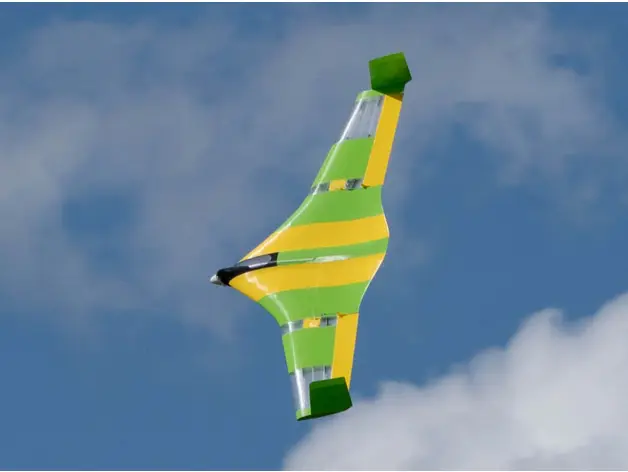
Flying Wing Buratinu
por Michael Christou en MyMiniFactory
The Buratinu is a smaller derivate of the Buratino which was designed by Bil in St. Petersburg.
Licencia
Solo uso personalMyMiniFactory - Credit - Remix - Noncommercial
Licencia de MyMiniFactory: puedes imprimirlo y remezclarlo dando crédito, sin fines comerciales.
Al descargar aceptas respetar la licencia y dar crédito a Michael Christou.
Archivos (26)
- Access Panel 1.Stl STL
- Access Panel 2.Stl STL
- Access Panel Bracket 1.Stl STL
- Access Panel Bracket 2.Stl STL
- Bushing For M3.Stl STL
- Bushing M4.Stl STL
- Cut Out Template.stl STL
- Elevon Inner 4 3D.stl STL
- Elevon Joint.stl STL
- Elevon Outer 4 3D.stl STL
- Fuselage 1.Stl STL
- Fuselage 2.Stl STL
- Fuselage 3.Stl STL
- Leveling Hook.stl STL
- Servo Mount Dymond.stl STL
- W1 Front Brim.stl STL
- W1 Middle.stl STL
- W1 Rear Brim.stl STL
- W2 Front Brim.stl STL
- W2 Rear Brim.stl STL
- W3 Servo.stl STL
- w4.stl STL
- w5.stl STL
- w6.stl STL
- Winglet Slim.stl STL
- winglet.stl STL
- Categoría
- Varios
- Formatos
- STL
- Descargas
- 1,924
- Publicado
Sobre este modelo
The Buratinu is a smaller derivate of the Buratino which was designed by Bil in St. Petersburg. Thank you Bil for the great design. With its pointed nose I was optimistic that I would manage the CG problem, which is always tricky with printed planes. The original has a wingspan of 1800 mm. I designed it for a wingspan of 1300 mm with slightly more sweep back.
The video is on YouTube youtube.com/watch?v=HTmxjgw0Mq4&t=165s
Detailed information about the development from the beginning and a lot pictures of the parts can be found on rc-network rc-network.de/forum/showthread.php/682097-Drohne-aus-St-Petersburg-drucken
Recommended Print Settings Attention The wings are designed to print using 0.5 mm width, 4 bottom and 4 top layers, no infill, 1 perimeter only. Should you print thinner walls, the perimeter of the upper side will not stick well enough to the perimeter of the inner stiffening construction. If you apply thicker walls, the perimeters will not come out continuously in one uninterrupted turn. The layers must build up as if you were printing in spiral vase mode. Only then you get a smooth surface on the upper side. If unsatisfied with the results, try out 0.49 or 0.48 width in your slices settings. It depends whether you use Cura, Slic3r, S3D or what you have. I suggest you experiment with some tests before printing the whole thing. The second point is: Should you print lesser layer heights, the inner stiffening construction will not connect well to the top and bottom layers. You will suffer a gap inbetween. All wing parts: layer height =0,3mm, width =0.5 mm, 1 perimeter, no infill W1, W2: 4 bottom layer, 4 top layer W3 servo: 3 bottom layer, 4 top layer W4, W5: 3 bottom layer, 3 top layer W6: 3 bottom layer, 5 top Layer
elevon inner: 6 bottom layers, spiral vase mode, no top layer elevon outer: 3 bottom layers, spiral vase mode, no top layer elevon joint: no bottom/top layer, spiral vase mode
All fuselage parts: layer height =0,2mm, width =0.5 mm fuselage 1: 3 perimeters, 12 bottom layers, 3 top layers, 40% infill fuselage 2: 3 perimeters, 2 bottom layer, 3 top layer, no infill fuselage 3: 2 perimeters, 2 bottom layers, 3 top layers, no infill access panel and bracket layer height =0.2 mm, width =0,5 mm spiral vase, no top/bottom layer
Specifications airfoils: own design wing span: 1300 mm wing chord: 480/140 mm CoG: 113 mm overall weight: 1245 g wing weight one side complet: 342 g wing area: 32 dm² wing loading: 39 g/dm² motor: Propdrive 28-36 1200KV static thrust: 1200 g (3S Lipo) battery: Turnigy 1800 mAh 3S 40~50C Lipo motor camber: tilted -1.5 degrees
Descripción original del autor, publicada en MyMiniFactory.