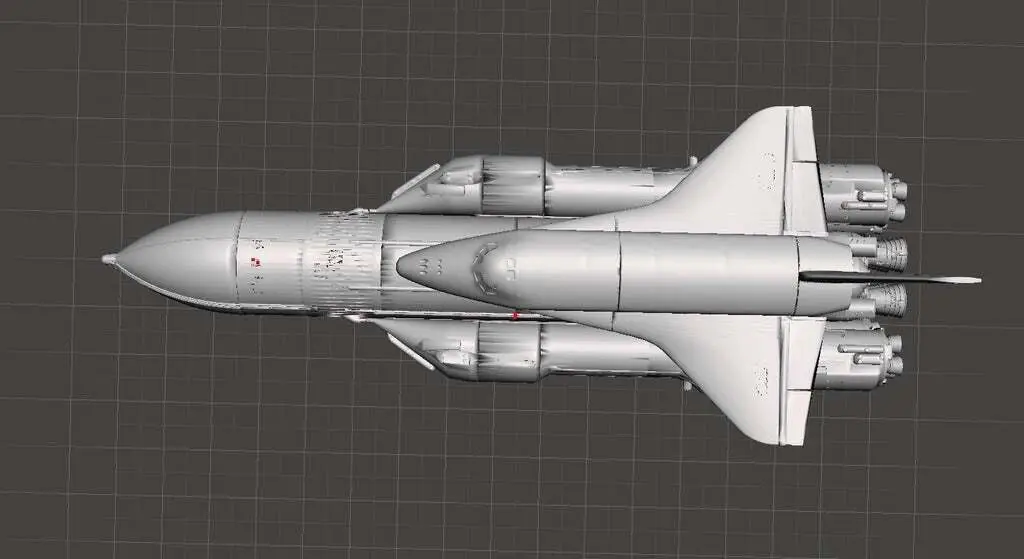
Energiya Buran (Russian Space Shuttle) Energy Rocket (Buran programme)
por Boris3dStudio en Cults3D
If you want me make some of yours, just ask me in Instagram Direct @boris3dstudio https://www.instagram.com/boris3dstudio/
Cults3D entrega los archivos a usuarios con cuenta gratuita
Licencia
Uso comercial permitidoPuedes imprimirlo, modificarlo y venderlo dando crédito al autor.
Al descargar aceptas respetar la licencia y dar crédito a Boris3dStudio.
Archivos (1)
- Energia-BuranM_All_Res.stl STL
- Categoría
- Miniaturas
- Formatos
- STL
- Descargas
- 2,400
- Publicado
Sobre este modelo
If you want me make some of yours, just ask me in Instagram Direct @boris3dstudio https://www.instagram.com/boris3dstudio/
The Buran programme (Russian: Бура́н, IPA: [bʊˈran], "Snowstorm" or "Blizzard"), also known as the "VKK Space Orbiter programme" ("VKK" is for Russian: Воздушно Космический Корабль, "Air Space Ship"),[1] was a Soviet and later Russian reusable spacecraft project that began in 1974 at the Central Aerohydrodynamic Institute in Moscow and was formally suspended in 1993.[2] In addition to being the designation for the whole Soviet/Russian reusable spacecraft project, Buran was also the name given to Orbiter K1, which completed one uncrewed spaceflight in 1988 and was the only Soviet reusable spacecraft to be launched into space. The Buran-class orbiters used the expendable Energia rocket as a launch vehicle. They are generally treated as a Soviet equivalent of the United States' Space Shuttle, but in the Buran project, only the airplane-shaped orbiter itself was theoretically reusable. While Orbiter K1 was recovered successfully after its first orbital flight in 1988, it was never reused.
The Buran programme was started by the Soviet Union as a response to the United States Space Shuttle program.[3] The project was the largest and the most expensive in the history of Soviet space exploration.[2] Development work included sending BOR-5 test vehicles on multiple sub-orbital test flights, and atmospheric flights of the OK-GLI aerodynamic prototype. Buran completed one uncrewed orbital spaceflight in 1988 before its cancellation in 1993.[2] Orbiter K1, which flew the test flight in 1988 was crushed in a hangar collapse on 12 May 2002 in Kazakhstan. The OK-GLI resides in Technikmuseum Speyer. Although the Buran class was similar in appearance to NASA's Space Shuttle orbiter, and could similarly operate as a re-entry spaceplane, its internal and functional design was distinct. For example, the main engines during launch were on the Energia rocket and were not taken into orbit by the spacecraft. Smaller rocket engines on the craft's body provided propulsion in orbit and de-orbital burns.
Introduction
This section needs additional citations for verification. Please help improve this article by adding citations to reliable sources. Unsourced material may be challenged and removed.
Find sources: "Buran programme" – news · newspapers · books · scholar · JSTOR (December 2015) (Learn how and when to remove this template message)
The Buran orbital vehicle programme was developed in response to the U.S. Space Shuttle programme, which in the 1980s raised considerable concerns among the Soviet military and especially Defense Minister Dmitry Ustinov. An authoritative chronicler of the Soviet and later Russian space programmes, the academic Boris Chertok, recounts how the programme came into being.[4] According to Chertok, after the U.S. developed its Space Shuttle programme, the Soviet military became suspicious that it could be used for military purposes, due to its enormous payload, several times that of previous U.S. launch vehicles. The Soviet government asked the TsNIIMash (ЦНИИМАШ, Central Institute of Machine-building, a major player in defense analysis) for an expert opinion. Lieutenant General Yuri Mozzhorin recalled that by "approximately 1965," when the Soviet Union had the 'long arm' (ICBMs), the Soviets did not expect war "and thought it would not happen."[5] As institute director, Mozzhorin, recalled that for a long time the institute could not envisage a civilian payload large enough to require a vehicle of that capacity.[citation needed]
Officially, the Buran orbital vehicle was designed for the delivery to orbit and return to Earth of spacecraft, cosmonauts, and supplies. Both Chertok and Gleb Lozino-Lozinskiy (Chief Designer of RKK Energia) suggest that from the beginning, the programme was military in nature; however, the exact military capabilities, or intended capabilities, of the Buran programme remain classified. Commenting on the discontinuation of the programme in his interview to New Scientist, Russian cosmonaut Oleg Kotov confirms their accounts:
We had no civilian tasks for Buran and the military ones were no longer needed. It was originally designed as a military system for weapon delivery, maybe even nuclear weapons. The American shuttle also has military uses.[6]
Like its American counterpart, the Buran orbital vehicle, when in transit from its landing sites back to the launch complex, was transported on the back of a large jet aeroplane — the Antonov An-225 Mriya transport aircraft, which was designed in part for this task and remains the largest aircraft in the world to fly multiple times.[7] Before the Mriya was ready (after the Buran had flown), the Myasishchev VM-T Atlant, a variant on the Soviet Myasishchev M-4 Molot (Hammer) bomber (NATO code: Bison), fulfilled the same role.
History of the Buran programme
The Buran orbiter ranks among the world's first spaceplanes, with the North American X-15, the Space Shuttle, SpaceShipOne, and the Boeing X-37. Of these, only the Buran and X-37 spaceflights were uncrewed.
Background
The Soviet reusable space-craft programme has its roots in the very beginning of the space age, the late 1950s. The idea of Soviet reusable space flight is very old, though it was neither continuous, nor consistently organized. Before Buran, no project of the programme reached production.
The idea saw its first iteration in the Burya high-altitude jet aircraft, which reached the prototype stage. Several test flights are known, before it was cancelled by order of the Central Committee. The Burya had the goal of delivering a nuclear payload, presumably to the United States, and then returning to base. The cancellation was based on a final decision to develop ICBMs. The next iteration of the idea was Zvezda from the early 1960s, which also reached a prototype stage. Decades later, another project with the same name was used as a service module for the International Space Station. After Zvezda, there was a hiatus in reusable projects until Buran.
Programme development
The development of the Buran began in the early 1970s as a response to the U.S. Space Shuttle program. Soviet officials were concerned about a perceived military threat posed by the U.S. Space Shuttle. In their opinion, the Shuttle's 30-ton payload-to-orbit capacity and, more significantly, its 15-ton payload return capacity, were a clear indication that one of its main objectives would be to place massive experimental laser weapons into orbit that could destroy enemy missiles from a distance of several thousands of kilometers. Their reasoning was that such weapons could only be effectively tested in actual space conditions and that to cut their development time and save costs it would be necessary to regularly bring them back to Earth for modifications and fine-tuning.[8] Soviet officials were also concerned that the U.S. Space Shuttle could make a sudden dive into the atmosphere to drop bombs on Moscow.[9]
Soviet engineers were initially reluctant to design a spacecraft that looked superficially identical to the Shuttle, but subsequent wind tunnel testing showed that NASA's design was already ideal.[10] Even though the Molniya Scientific Production Association proposed its Spiral programme design (halted 13 years earlier), it was rejected as being altogether dissimilar from the American shuttle design. While NPO Molniya conducted development under the lead of Gleb Lozino-Lozinskiy, the Soviet Union's Military-Industrial Commission, or VPK, was tasked with collecting all data it could on the U.S. Space Shuttle. Under the auspices of the KGB, the VPK was able to amass documentation on the American shuttle's airframe designs, design analysis software, materials, flight computer systems and propulsion systems. The KGB targeted many university research project documents and databases, including Caltech, MIT, Princeton, Stanford and others. The thoroughness of the acquisition of data was made much easier as the U.S. shuttle development was unclassified.[11]
The construction of the shuttles began in 1980, and by 1984 the first full-scale Buran was rolled out. The first suborbital test flight of a scale-model (BOR-5) took place as early as July 1983. As the project progressed, five additional scale-model flights were performed. A test vehicle was constructed with four jet engines mounted at the rear; this vehicle is usually referred to as OK-GLI, or as the "Buran aerodynamic analogue". The jets were used to take off from a normal landing strip, and once it reached a designated point, the engines were cut and OK-GLI glided back to land. This provided invaluable information about the handling characteristics of the Buran design, and significantly differed from the carrier plane/air drop method used by the United States and the Enterprise test craft. Twenty-four test flights of OK-GLI were performed by the Gromov Flight Research Institute test pilots and researchers after which the shuttle was "worn out". The developers considered using a couple of Mil Mi-26 helicopters to "bundle" lift the Buran, but test flights with a mock-up showed how risky and impractical that was.[12] The VM-T ferried components[13] and the Antonov An-225 Mriya (the heaviest airplane ever) was designed and used to ferry the shuttle.[14][15]
The flight and ground-testing software also required research. In 1983 the Buran developers estimated that the software development would require several thousand programmers if done with their existing methodology (in assembly language), and they appealed to Keldysh Institute of Applied Mathematics for assistance. It was decided to develop a new high-level "problem-oriented" programming language. Researchers at Keldysh developed two languages: PROL2 (used for real-time programming of onboard systems) and DIPOL (used for the ground-based test systems), as well as the development and debugging environment SAPO PROLOGUE.[16] There was also an operating system known as Prolog Manager.[17] Work on these languages continued beyond the end of the Buran project, with PROL2 being extended into SIPROL,[18] and eventually all three languages developed into DRAKON which is still in use in the Russian space industry. A declassified May 1990 CIA report citing open-source intelligence material states that the software for the Buran spacecraft was written in "the French-developed programming language known as Prolog",[19] possibly due to confusion with the name PROLOGUE.
Flight crew preparation
Main article: List of human spaceflight programs
Until the end of the Soviet Union in 1991, seven cosmonauts were allocated to the Buran programme and trained on the OK-GLI ("Buran aerodynamic analogue") test vehicle. All had experience as test pilots. They were: Ivan Ivanovich Bachurin, Alexei Sergeyevich Borodai, Anatoli Semyonovich Levchenko, Aleksandr Vladimirovich Shchukin, Rimantas Antanas Stankevičius, Igor Petrovich Volk and Viktor Vasiliyevich Zabolotsky.
A rule, set in place for cosmonauts because of the failed Soyuz 25 of 1977, insisted that all Soviet space missions contain at least one crew member who has been to space before. In 1982, it was decided that all Buran commanders and their back-ups would occupy the third seat on a Soyuz mission, prior to their Buran spaceflight. Several people had been selected to potentially be in the first Buran crew. By 1985, it was decided that at least one of the two crew members would be a test pilot trained at the Gromov Flight Research Institute (known as "LII"), and potential crew lists were drawn up. Only two potential Buran crew members reached space: Igor Volk, who flew in Soyuz T-12 to the space station Salyut 7, and Anatoli Levchenko who visited Mir, launching with Soyuz TM-4 and landing with Soyuz TM-3. Both of these spaceflights lasted about a week.[8]
Levchenko died of a brain tumour the year after his orbital flight, Bachurin left the cosmonaut corps because of medical reasons, Shchukin was assigned to the back-up crew of Soyuz TM-4 and later died in a plane crash, Stankevičius was also killed in a plane crash, while Borodai and Zabolotsky remained unassigned to a Soyuz flight until the Buran programme ended.
Spaceflight of I. P. Volk
Main article: Soyuz T-12
Igor Volk was planned to be the commander of the first crewed Buran flight. There were two purposes of the Soyuz T-12 mission, one of which was to give Volk spaceflight experience. The other purpose, seen as the more important factor, was to beat the United States and have the first spacewalk by a woman.[8] At the time of the Soyuz T-12 mission the Buran programme was still a state secret. The appearance of Volk as a crew member caused some, including the British Interplanetary Society magazine Spaceflight, to ask why a test pilot was occupying a Soyuz seat usually reserved for researchers or foreign cosmonauts.[20]
Spaceflight of A. S. Levchenko
Anatoli Levchenko was planned to be the back-up commander of the first crewed Buran flight, and in March 1987 he began extensive training for his Soyuz spaceflight.[8] In December 1987, he occupied the third seat aboard Soyuz TM-4 to Mir, and returned to Earth about a week later on Soyuz TM-3. His mission is sometimes called Mir LII-1, after the Gromov Flight Research Institute shorthand.[21] When Levchenko died the following year, it left the back-up crew of the first Buran mission again without spaceflight experience. A Soyuz spaceflight for another potential back-up commander was sought by the Gromov Flight Research Institute, but never occurred.[8]
Descripción original del autor, publicada en Cults3D.