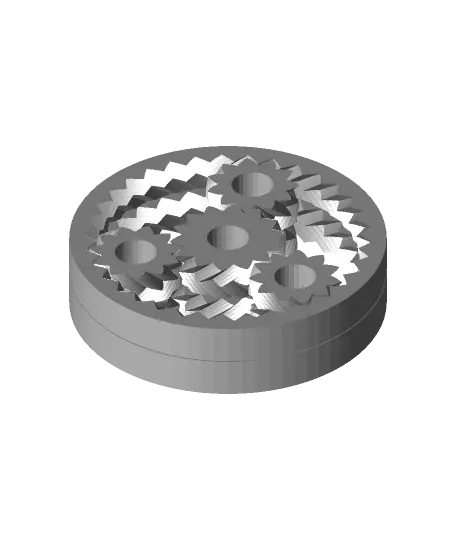
Compound Planetary Gears 1300:1
Model originally uploaded to Thingiverse at https://www.thingiverse.com/thing:3497579.
Thangs entrega los archivos a usuarios con cuenta gratuita
Licencia
Revisa las condicionesLICENSE
El autor usa su propia licencia. Revisa sus condiciones en la página original antes de compartir, modificar o vender.
Al descargar aceptas respetar la licencia y dar crédito a Troy M.
Archivos (1)
- Compound7.stl STL
- Categoría
- Repuestos
- Formatos
- STL
- Descargas
- 223
- Publicado
Sobre este modelo
Model originally uploaded to Thingiverse at https://www.thingiverse.com/thing:3497579.
UPDATE: This is old news and has been done before. It is the basis for gearboxes such as High Torque 149.33:1 Compound Planetary Gear set (https://www.thingiverse.com/thing:2550882). Check out Solid Core Compound Planetary Gearbox (https://www.thingiverse.com/thing:3511382) for something new* - a single piece sun gear version with similar high ratios.
This is a print-in-place compound planetary gearbox. There are two planetary stages stacked vertically. The old trick of having one tooth fewer in one ring to emulate a cycloidal drive has been extended by noting that we do not require the same gear pitch (or rather number of planet teeth) in both stages. This way we can achieve a fractional differential between the outer rings and ridiculous gear ratios.
As an example, consider (Np/Nr) of 10/31 and 11/34 in the two stages. These give a very close ratio of 1:340 relative to each other. Multiply this by the gear ratio of the first planetary gear with fixed ring, driven by the sun of 1:3.818 and we obtain a final gear ratio of 1:1298.18...
Just be sure to separate the ring and sun gears before turning (there should be a one-layer gap after slicing). A sharpened spatula works well as long as there is enough space between planet gears to get a corner in. For a tightly packed arrangement it may be possible to thread piano wire around the sun gears and crack them apart.
Here's a quick example spreadsheet (https://docs.google.com/spreadsheets/d/1uYKKAWmQ7zif1EQtZG-QP4luj-qRsDD3NsaC1B5WHww) to calculate not quite matching ratios.
(* It's probably been done before, but I can't find any examples)
Descripción original del autor, publicada en Thangs.