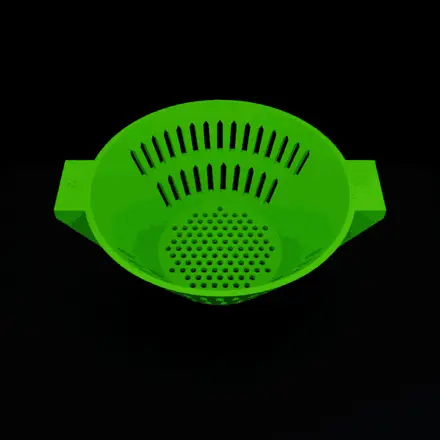
Colander 100 mm - pasta strainer, medium 2.5 mm holes, kitchen sieve, no supports
por ToolingLab3D en Cults3D
Colander 100 mm - pasta strainer, medium 2.5 mm holes, kitchen sieve, no supports
Cults3D entrega los archivos a usuarios con cuenta gratuita
Licencia
Solo uso personalLicencia de uso privado de Cults3D: puedes imprimirlo para ti. No se permite compartir el archivo ni vender las impresiones.
Al descargar aceptas respetar la licencia y dar crédito a ToolingLab3D.
Archivos (5)
- README.txt TXT
- SB-KU-100-L25-drawing.pdf PDF
- SB-KU-100-L25.3mf 3MF
- SB-KU-100-L25.step STEP
- SB-KU-100-L25.stl STL
- Categoría
- Hogar
- Formatos
- TXT, PDF, 3MF, STEP, STL
- Descargas
- 0
- Publicado
Sobre este modelo
Colander 100 mm - pasta strainer, medium 2.5 mm holes, kitchen sieve, no supports
What it is
A round kitchen colander, 100 mm at the top and 40 mm deep, for pasta, salad and vegetables. The flat bottom has 97 holes of 2.5 mm, the 30 degree wall 50 slots of 2.5 mm - so water runs off at the bottom and at the sides. Two grip ledges at the rim. The colander stands on its flat bottom and prints in one piece without supports.
Finer than about 1 mm is not reliable with a 0.4 mm nozzle - for flour, tea or coffee lay a piece of nylon mesh, cheesecloth or a paper filter into the sieve.
Free sample
This model is free - an honest sample of the series, so you can check fit, hole size and print settings on your own printer before you buy. The family has 12 models, it is also available as a discounted set, and the complete set holds all 60 sieves of the series (colanders, stackable sieve inserts, sink and drain strainers, paint strainers, fan dust filters, aquarium intake strainers and XXL sieves).
What goes with it
optional: nylon mesh, cheesecloth or paper filter for anything finer than 1 mm
Which filament - food contact, heat, chemicals
Food contact: no 3D print is food-safe by itself - food residue and germs settle in the layer lines. Use a filament with a food-contact declaration of the maker (EU 10/2011 and/or FDA 21 CFR 177), print with a stainless steel nozzle (brass nozzles can contain lead), wash the part right after use and replace it when the surface gets rough. All at your own risk.
Hot pasta or potato water (close to 100 °C): PP (polypropylene) with food-contact declaration - it stays firm up to about 100 °C. PETG softens from about 70-80 °C: use it cold (salad, berries, rinsing rice) or let the water cool down first. PLA never with hot food (soft from about 55 °C).
Dishwasher: PP yes (top rack), PETG only on a cool programme, PLA no.
Dimensions (measured on the CAD solid)
As printed: 118.84 x 100 x 40 mm
97 holes Ø 2.5 mm (measured 2.5-2.5), pitch 4.3 mm
open area of the bottom 18.6 %
50 wall slots 2.5 mm, 50° roof
top Ø 100 mm, bottom Ø 53.81 mm, wall 30°
grips 2 x 9.42 mm
Weight in PETG, printed solid: about 49 g (less with normal infill)
A dimensioned drawing (PDF) is in the download.
Printing
Orientation: as in the file - bottom on the bed; fits any 220 x 220 mm bed
Supports: none. Holes stand vertical, wall slots have a 50 degree roof, rims and grips are 50 degrees underneath
0.4 mm nozzle, 0.2 mm layers, 3 walls, 15-30 % infill
Fine holes: first layer slow, elephant foot compensation 0.1-0.2 mm, no brim - so every hole stays open
In the download
SB-KU-100-L25.stl / .3mf / .step
SB-KU-100-L25-drawing.pdf
README.txt with filament advice
Descripción original del autor, publicada en Cults3D.