CleatGrid - Modular French Cleat Tool Holder
por heyoh en MakerWorld
Stop building a plywood holder for every tool. CleatGrid is a printed grid plate that hooks straight onto a standard 3/4" plywood French cleat. Modular blocks peg into its 20 mm grid and screw in from behind, so you can build a rock-solid holder for almost any tool.
MakerWorld entrega los archivos a usuarios con cuenta gratuita
Licencia
Uso comercial permitidoPuedes imprimirlo, modificarlo y venderlo dando crédito al autor.
Al descargar aceptas respetar la licencia y dar crédito a heyoh.
Archivos (7)
- cleatgrid_plate_12x12.stl STL · 2,4 MB
- cleatgrid_ledge_lip_6x1_d95.stl STL · 37 KB
- cleatgrid_ledge_4x1_d60.stl STL · 24 KB
- cleatgrid_ledge_3x1_d50.stl STL · 19 KB
- cleatgrid_fork_4x1_hammer.stl STL · 28 KB
- cleatgrid_driver_rack_6x1.stl STL · 133 KB
- cleatgrid_plate_12x5_short.stl STL · 1011 KB
- Categoría
- Herramientas
- Formatos
- STL
- Descargas
- 0
- Publicado
Sobre este modelo
Stop building a plywood holder for every tool. CleatGrid is a printed grid plate that hooks straight onto a standard 3/4" plywood French cleat. Modular blocks peg into its 20 mm grid and screw in from behind, so you can build a rock-solid holder for almost any tool. How it works
- Measure your tool.
- Pick blocks and peg them into the grid.
- Screw each block in from behind and hang the plate on your cleat.
What's included (v1)
- Plate 12x12: 240 x 240 mm (9.4 in square), 144 pockets on a 20 mm grid, 31 mm deep including the cleat hook.
- Short plate 12x5: 240 x 100 mm (9.4 x 3.9 in), 60 pockets, no heel. Its back rests flat on the wood cleat, so it suits tools that hang straight down, like hammers and drivers.
- Lip ledge 6x1: 119 mm wide, reaches 95 mm out. The 12 mm lip stops a tool sliding off.
- Ledge 4x1: 79 mm wide, reaches 60 mm out. Use it flat or upright as a stop.
- Ledge 3x1: 59 mm wide, reaches 50 mm out. Use it flat or upright as a stop.
- Hammer fork 4x1: 79 mm wide, reaches 70 mm out, with a 36 mm slot. Hammers and mallets hang by the neck.
- Driver rack 6x1: 119 mm wide, reaches 80 mm out. Six 13 mm holes in two staggered rows hold full-size screwdrivers.
Example builds (in the photos)
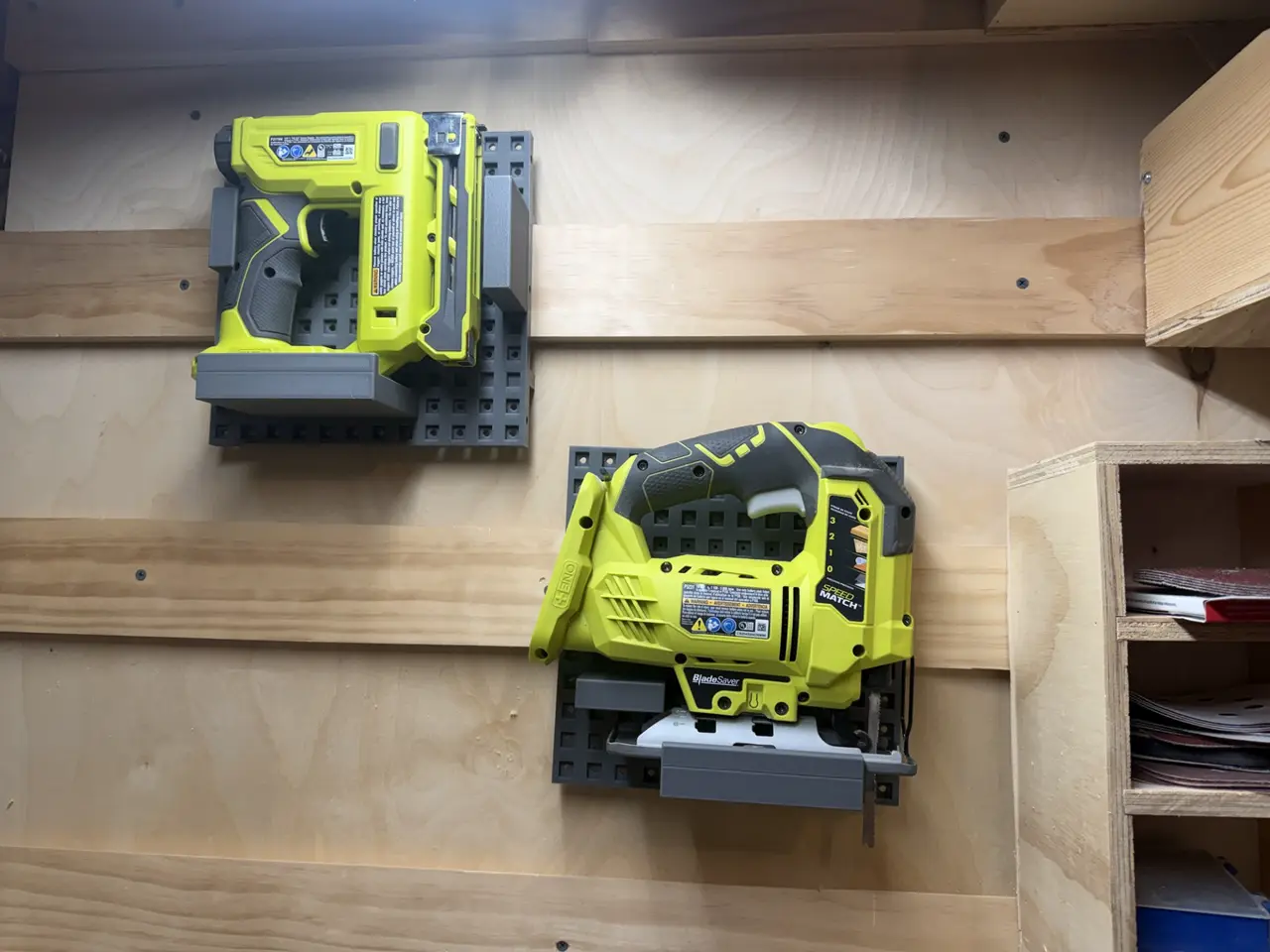
- Ryobi P5231 jigsaw: lip ledge 6x1 and ledge 4x1.
- Ryobi P317VN crown stapler: lip ledge 6x1 along the bottom, the 4x1 upright under the trigger, and the 3x1 upright beside the magazine.
- Hand tools on the short plate: driver rack 6x1 holding six screwdrivers, plus a hammer fork holding a mallet.
Hardware
- #6 x 1/2" pan-head self-tapping screws, one per peg, driven from the back of the plate.
- The hook row (the 4th row down on the 12x12, the 2nd row down on the 12x5) can't be reached from behind. Use CA glue there, or a #6 x 5/8" screw from the front.
- Use a 2" driver bit for the rows on either side of the 12x12's bottom heel.
Print settings (Bambu Lab P1S, 0.4 nozzle, PLA)
- 0.2 mm layers, 3 walls, 15% grid infill, no supports, 5 mm outer brim.
- Turn on Avoid crossing wall (Quality > Advanced). Without it the plate strings.
- Plates print on edge with the hook profile on the bed. Ignore Bambu's "floating cantilever" warning.
- Blocks print face down, pegs up.
- Plate 1 (the 12x12 plate) takes 11h 6m and 399 g. Plate 2 (all five blocks) takes 5h 18m and 249 g. Plate 3 (the 12x5 short plate) takes 5h 7m and 183 g.
- If you see stringing, dry the filament or drop the nozzle to 205-210 C.
Good to know
- Square pegs stop the blocks from rotating, and the screw locks them in. Screws go in from behind, so set your layout before you hang the plate.
- Hanging two hammers? Print a second fork.
Descripción original del autor, publicada en MakerWorld.