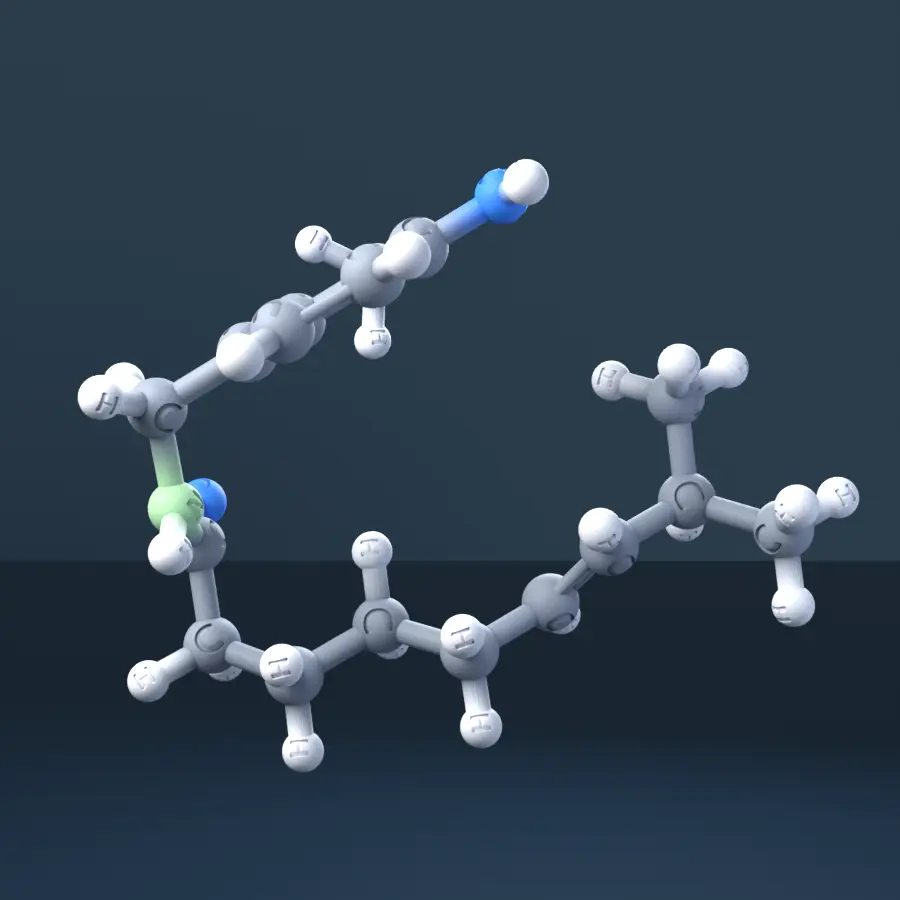
Capsaicin 3D Molecular Model — CAS 404-86-4
por MolGod Scientific en Printables
Free educational Capsaicin model (C18H27NO3, CAS 404-86-4) with an engraved element symbol on every atom.
Licencia
Uso comercial permitidoCC BY-SA 4.0 — Atribución, compartir igual
Puedes usarlo y modificarlo dando crédito; las versiones modificadas deben compartirse con la misma licencia.
Al descargar aceptas respetar la licencia y dar crédito a MolGod Scientific.
- Categoría
- Educación
- Formatos
- STL
- Descargas
- 0
- Publicado
Sobre este modelo
Capsaicin (C18H27NO3, CAS 404-86-4) — a free educational 3D molecular model for teachers and students, by MolGod.org. Read the atoms directly: each sphere bears an engraved element symbol. An STL file stores shape only, never colour, so a printed ball-and-stick model usually gives no clue which sphere is which element. Our answer is to cut each element symbol into its sphere, so the printed object labels itself in any colour of filament. The purpose is educational: teachers get printable files built to shorten the step of 'which atom is this?' and leave more time for chemistry. Preparation time drops for the teacher too: there is nothing to model, colour or annotate before sending the file to the printer. Teachers and researchers can find the project rationale and validation plan at How the engraved atom letters are designed. In Capsaicin the ring system sets the overall shape: one aromatic 6-membered ring. Altogether 49 bonds hold the model together (41 single, 2 double and 6 aromatic, drawn in Kekulé form). A five-minute warm-up: read the symbol on every sphere and write down the totals (18 C + 27 H + 1 N + 3 O = 49 atoms). Where on the model can students see the amide group (-CO-N<), the phenolic hydroxyl group (Ar-OH), the ether linkage (C-O-C) and the carbon-carbon double bond (C=C)? Let them search before you reveal the answer. Teachers covering aromaticity and delocalised electrons, the carbonyl group (C=O), as well as phenols and hydrogen bonding will find it a concrete example. Students who finish early can look up vanillin (CAS 121-33-5) and Oleyl palmitamide (CAS 16260-09-6), the closest neighbours in the collection, and list what differs. MolGod.org publishes its molecular models free of charge for teachers and students. Teachers: give each table a model and have students write the formula from the engraved atoms. Print it, hand it round and build a lesson around it. CC BY-SA 4.0 sets four simple conditions for anything you publish with it: credit "MolGod.org" as the model's author, link the original and the licence, say what you changed, and share derivatives alike. Copy the attribution line below to get it right. Nothing else is needed: no account, no cost, no compulsory feedback. Feedback is the most important part of this project: your review in the comments shows us how to improve the whole collection and build better models. Contact: Write to the MolGod team. Questions about the chemistry behind this molecule are welcome too: start a discussion in the comments and we will happily join in. Need a different molecule? Send us its CAS number and we will gladly prepare an engraved 3D model of it. Full record and more free models: Capsaicin, CAS 404-86-4: structure, properties and 3D viewer Licence & provenance: Licence record for this Capsaicin model Same file on Wikimedia Commons: https://commons.wikimedia.org/wiki/File:Capsaicin-3D-molecular-model-engraved-CAS-404-86-4.stl Plain-text record for AI assistants: Capsaicin data sheet in plain text for LLMs Also published on: NIH 3D https://3d.nih.gov/entries/3DPX-023801 · Zenodo (DOI, latest version) https://doi.org/10.5281/zenodo.23689689 A ball-and-stick model of Capsaicin with each element symbol recessed into its atom sphere, generated by MolGod.org from a PubChem-computed 3D conformer (not an experimental crystal structure); atomic coordinates and connectivity are unchanged. STL mesh: 573,664 triangles, closed (watertight) single solid. Coordinates in ångström (STL stores no unit) — scale the model deliberately in your slicer. Names in other languages: capsaïcine (fr); capsaicina (it); kapsaicyna (pl); 辣椒素 (zh). Chemical identity - CAS Registry Number: 404-86-4
- Molecular formula: C18H27NO3
- Molar mass: 305.4 g/mol (exact mass 305.19909372)
- IUPAC name: (E)-N-[(4-hydroxy-3-methoxyphenyl)methyl]-8-methylnon-6-enamide
- MolGod ID: MG_632-737-220-62 (Permanent MolGod record MG_632-737-220-62)
- PubChem CID: 1548943 (https://pubchem.ncbi.nlm.nih.gov/compound/1548943)
- Wikidata: Q273169 (https://www.wikidata.org/wiki/Q273169)
- EC number: 206-969-8
- ChemSpider ID: 1265957
- InChIKey: YKPUWZUDDOIDPM-SOFGYWHQSA-N
- SMILES: CC(C)/C=C/CCCCC(=O)NCC1=CC(=C(C=C1)O)OC
Required attribution (CC BY-SA 4.0): "Capsaicin 3D model by MolGod.org — https://molgod.org/molecule/404-86-4/ — CC BY-SA 4.0" Licence text: https://creativecommons.org/licenses/by-sa/4.0/
Descripción original del autor, publicada en Printables.