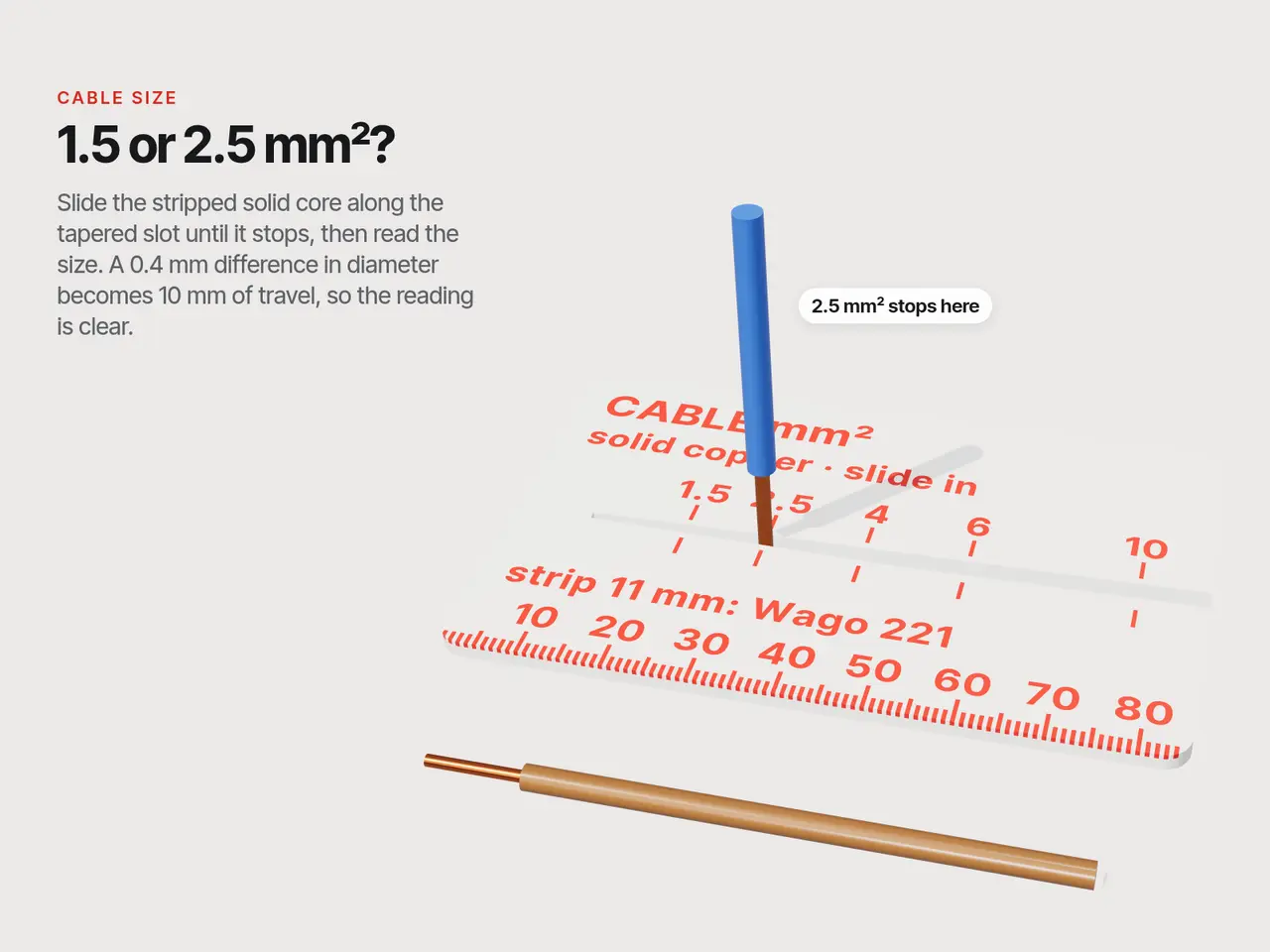
Cable Size Gauge Card – 1.5 or 2.5 mm²?
por tatutsa888 en Printables
Slide a stripped solid wire into the taper and read its size: 1.5, 2.5, 4, 6 or 10 mm². Credit-card size, no supports.
Licencia
Uso comercial permitidoPuedes imprimirlo, modificarlo y venderlo dando crédito al autor.
Al descargar aceptas respetar la licencia y dar crédito a tatutsa888.
Archivos (4)
- Categoría
- Herramientas
- Formatos
- 3MF, STL
- Descargas
- 3
- Publicado
Sobre este modelo
Is this 1.5 or 2.5 mm² wire? On a solid copper conductor the difference is only 0.4 mm in diameter: too small for a row of printed holes to tell reliably. So this card uses a long tapered slot instead. How to use it - Strip the wire, then slide the bare solid core into the open end of the slot (right edge) and along it until it stops.
- Read the size where it stops: 1.5, 2.5, 4, 6 or 10 mm². The slot narrows by 3 mm over 75 mm, so 0.4 mm of diameter becomes 10 mm of travel: easy to read, and forgiving of small printing errors.
- Marks are set for solid (class 1) copper, the stiff wire used in fixed house wiring: 1.38, 1.78, 2.26, 2.76 and 3.57 mm. Stranded flexible wire squashes and reads wrong.
- Reminder printed on the card: strip 11 mm for Wago 221 connectors. The ruler along the bottom edge shows it.
- This is an identification aid, not a safety tool. Always switch off and follow your local wiring rules.
Print settings - PLA, 0.2 mm layers, 2.2 mm thick, flat, marked face up, no supports, 100 % infill.
- The 3MF assigns red to slot 1 and white to slot 2 (MMU3). Red is a 0.6 mm inlay. For one colour, print carte-cables.stl.
Accuracy - The slot has 0.1 mm of clearance. First prints are being tested; I will adjust here if needed.
Part of the same series as the Wallet Workshop Gauges: same size, same ruler. Designed with AI assistance (parametric Python script, manifold3d). En français Carte jauge de section de câble, format carte bancaire. On glisse l'âme rigide dénudée dans la fente en biseau jusqu'à ce qu'elle bloque, et on lit la section : 1,5, 2,5, 4, 6 ou 10 mm². 0,4 mm d'écart de diamètre devient 10 mm de course : lecture nette, tolérante aux petites erreurs d'impression. Pour fil rigide (classe 1) uniquement. Rappel : dénuder 11 mm pour un Wago 221.
Descripción original del autor, publicada en Printables.