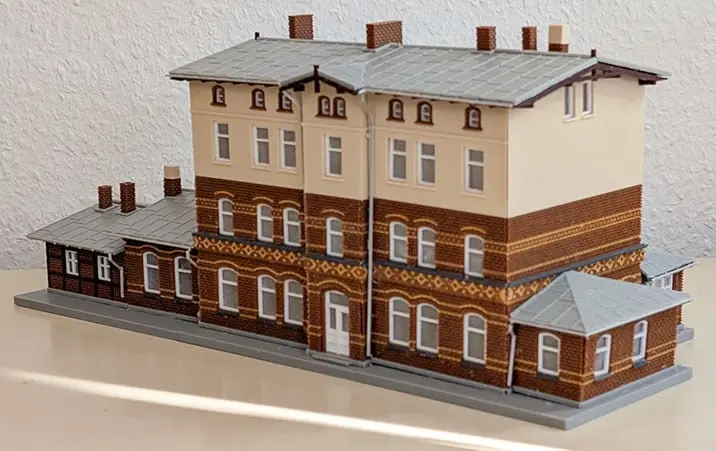
Brandenburg Altstadt train station H0 scale kit detailed model
por Thomas Greutmann en Thingiverse
Brandenburg is a mid-size town located southwest of Berlin. The Brandenburg Altstadt station (“Old town”) is a secondary station, built in 1904 as a local stop for two branch lines into the countryside and hosting a substantial marshalling yard for freight trains to the local heavy industry. The...
Licencia
Uso comercial permitidoCC BY-SA 4.0 — Atribución, compartir igual
Puedes usarlo y modificarlo dando crédito; las versiones modificadas deben compartirse con la misma licencia.
Al descargar aceptas respetar la licencia y dar crédito a Thomas Greutmann.
Archivos (26)
- Bf_Brandenburg_Altstadt.3mf 3MF · 5,9 MB
- Bf_Brandenburg_Base_Plate_1.stl STL · 94 KB
- Bf_Brandenburg_Base_Plate_2.stl STL · 59 KB
- Bf_Brandenburg_Base_Plate_3.stl STL · 48 KB
- Bf_Brandenburg_Black_1.stl STL · 1,4 MB
- Bf_Brandenburg_Brick_Parts_2.stl STL · 2,6 MB
- Bf_Brandenburg_Brick_Parts_5.stl STL · 1,5 MB
- Bf_Brandenburg_Brick_Walls_1.stl STL · 2,7 MB
- Bf_Brandenburg_Brick_Walls_5.stl STL · 1,5 MB
- Bf_Brandenburg_Brick_Walls_8.stl STL · 2,3 MB
- Bf_Brandenburg_Brick_Walls_11.stl STL · 2,9 MB
- Bf_Brandenburg_Brown.stl STL · 141 KB
- Bf_Brandenburg_Gray_1.stl STL · 831 KB
- Bf_Brandenburg_Plain_Walls_1.stl STL · 155 KB
- Bf_Brandenburg_Plain_Walls_3.stl STL · 146 KB
- Bf_Brandenburg_Plain_Walls_5.stl STL · 81 KB
- Bf_Brandenburg_Plain_Walls.stl STL · 79 KB
- Bf_Brandenburg_Roof_2.stl STL · 3,1 MB
- Bf_Brandenburg_Roof_3.stl STL · 1,3 MB
- Bf_Brandenburg_Silver.stl STL · 1,2 MB
- Bf_Brandenburg_Translucent.stl STL · 274 KB
- Bf_Brandenburg_White_2.stl STL · 808 KB
- Bf_Brandenburg_Yellow_Brick_1.stl STL · 2,0 MB
- Bf_Brandenburg_Yellow_Brick_2.stl STL · 509 KB
- Bf_Brandenburg_Yellow_Brick.stl STL · 691 KB
- Brandenburg_Station_Instructions.pdf PDF · 4,1 MB
- Categoría
- Varios
- Formatos
- 3MF, STL, PDF
- Descargas
- 340
- Publicado
Sobre este modelo
Brandenburg is a mid-size town located southwest of Berlin. The Brandenburg Altstadt station (“Old town”) is a secondary station, built in 1904 as a local stop for two branch lines into the countryside and hosting a substantial marshalling yard for freight trains to the local heavy industry. The station building is a fairly typical example of midsize turn-of-the-20th-century station buildings in northern Germany. It is a squat multi-storey construction built of brick – the ubiquitious building material in northern Germany - , with a gently sloped tar-coated roof and some attached smaller building parts and sheds. You will find many similar station buildings all over the northern German flat lands, from east to west – the turn of the century was a boom time for railway construction here. What is special about this station building is the brick mosaic all around the main building, using bright yellow bricks inserted into the otherwise brownish brick walls. The bricklayers have done a wonderful job here. While single color brick artwork is very common on buildings from that period, multi-colored decorations are quite unusual. I put a lot of effort into recreating the original brick mosaic in this model. While one of the branch lines still has a regular hourly passenger service the other branch line has been closed and dismantled. The marshalling yard still sees some action , but traffic is reduced as some of the heavy industry plants have been closed. So, the station building shares the fate of so many small and midsize station buildings and has been closed. Currently it is in a very sorry state. Windows and doors are boarded up, the walls are painted with graffiti all over, and in 2025 the building was seriously damaged by fire. So in a way this model is not just a copy of this once proud building but an effort to bring it back to live. The model is in H0 model railway scale (1:87) and has over 660 parts that need to be assembled. I wanted a faithful and detailed replication of the brick decoration patterns and mosaics and designed a multi layer sandwich system to accomplish this, and the patterns require more than 300 parts alone. It is a complex and very detailed model that needs careful assembly, not a model for beginners. Some solid experience in plastic model assembly is helpful, as well as patience and calm hands (both of which I lack). I designed it using Tinkercad and have printed my copies on a Bambu Lab X1C printer using PLA filament. The joints and part fittings are designed with tolerances of 0,2mm, which should give a good fit – not too tight, not too loose. You may have to cut and file some edges after print. A PDF file with step-by-step assembly instructions is included. Enjoy.
Descripción original del autor, publicada en Thingiverse.