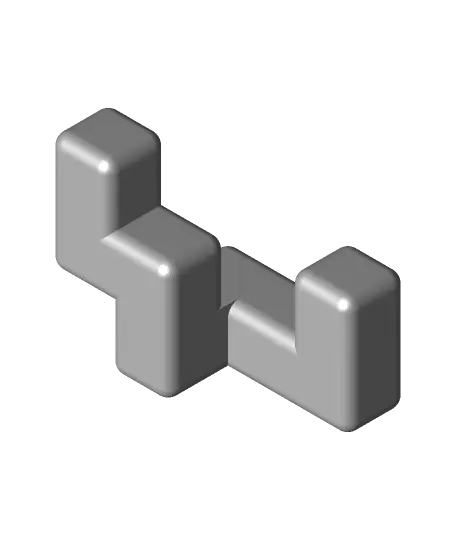
Brain Breaker Blocks
por DaveMakesStuff en Thangs
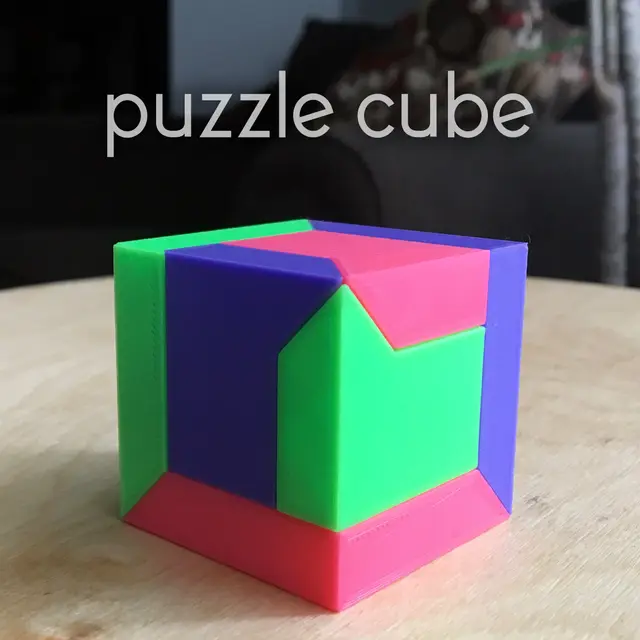
If you’re bored of Lego, this 3D printed self-interlocking construction block will break your brain. It takes minutes to print, months to figure out!
Thangs entrega los archivos a usuarios con cuenta gratuita
Licencia
Solo uso personalCC BY-NC-SA 4.0 — Atribución, no comercial, compartir igual
Uso personal dando crédito; sin fines comerciales y las modificaciones con la misma licencia.
Al descargar aceptas respetar la licencia y dar crédito a DaveMakesStuff.
Archivos (1)
- SL Block.stl STL · 408 KB
- Categoría
- Educación
- Formatos
- STL
- Descargas
- 81
- Publicado
Sobre este modelo
If you’re bored of Lego, this 3D printed self-interlocking construction block will break your brain. It takes minutes to print, months to figure out!
See here for video for demonstrates of the concepts outlined below: https://youtu.be/j10wzy0qGOg
Officially known as an “SL Block,” this octocube shape is part of a family of “topologically interlocking assemblies,” that is, shapes that hold together without the use of connectors or adhesives to form self-interlocking structures. Self-interlocking structures have interesting architectural and engineering applications.
A ends of a single “SL” block resemble an “S” and an “L.”. In assembly, SL blocks always occur in pairs, called a “Conjugate Pair.” In the pictures and video, conjugate pairs are shown with one white and one black piece.
Conjugate pairs lock together in six different ways, called “engagements,” to form “SL Strands.” Each type of engagement adds a unique translation or rotation to the SL Strand. The six types of engagements are denoted as “h,” “t,” “s,” “d,” “a” and “y.”
Using this system, the SL strands can be represented as strings consisting of six letters that stand for the six types of engagements.
The first example in the video is an “h4” SL Strand. “h” engagements are straight with no rotations or translations, so the strand is straight.
The next example is an “a4” SL Strand. “a” engagements create a 90 degree rotation but no translations, so the “a4” strand makes a closed, cube-shaped structure.
The final examples in the videos show more complicated “(as2)4” and “(dth)4” strands. These modules can then be connected to form larger and increasingly complex self-interlocking structures.
Is your brain broken yet? Interested in learning more? Start here: https://archive.bridgesmathart.org/2018/bridges2018-107.pdf
Descripción original del autor, publicada en Thangs.