Automatic Transmission Model
por Emmett Lalish en Thingiverse
Have you ever wondered how an automatic transmission works? I did, so I looked it up and then designed this desktop model. It has six forward speeds and one reverse. Real automatic transmissions have a hydraulic or electrical system that engages different clutches and brakes to shift gears...
Licencia
Uso comercial permitidoCC BY-SA 4.0 — Atribución, compartir igual
Puedes usarlo y modificarlo dando crédito; las versiones modificadas deben compartirse con la misma licencia.
Al descargar aceptas respetar la licencia y dar crédito a Emmett Lalish.
Archivos (23)
- gears.stl STL · 2,1 MB
- planets.stl STL · 2,4 MB
- stand.stl STL · 135 KB
- shaft.stl STL · 689 KB
- crank.stl STL · 128 KB
- pins.stl STL · 94 KB
- handle.stl STL · 87 KB
- carrier.stl STL · 721 KB
- anulus.stl STL · 4,2 MB
- sun.stl STL · 1,7 MB
- idler.stl STL · 603 KB
- planet1.stl STL · 794 KB
- planet2.stl STL · 1,2 MB
- back.stl STL · 121 KB
- front.stl STL · 119 KB
- brace.stl STL · 102 KB
- pin1.stl STL · 117 KB
- pin2.stl STL · 119 KB
- pin3.stl STL · 111 KB
- transmission.m M · 2 KB
- back_loose.stl STL · 127 KB
- front_loose.stl STL · 125 KB
- transmission.scad SCAD · 9 KB
- Categoría
- Educación
- Formatos
- STL, M, SCAD
- Descargas
- 198,252
- Publicado
Sobre este modelo
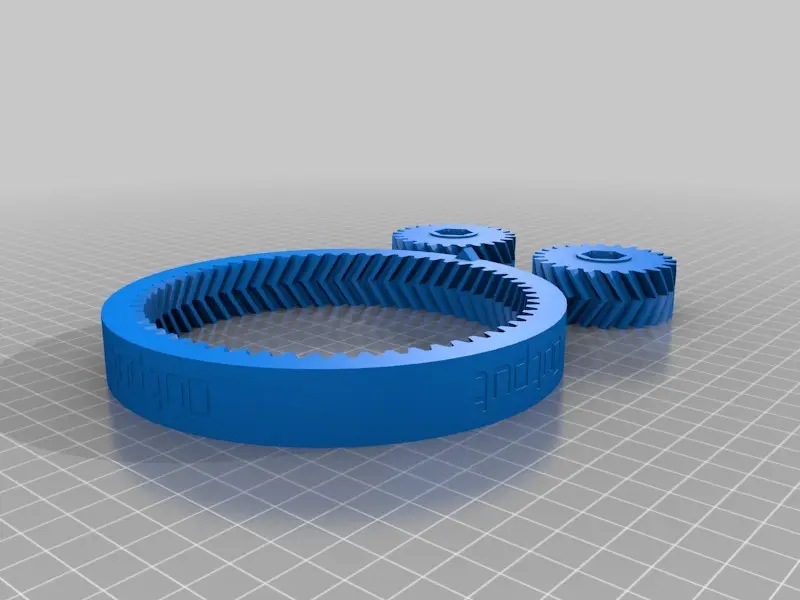
Have you ever wondered how an automatic transmission works? I did, so I looked it up and then designed this desktop model. It has six forward speeds and one reverse. Real automatic transmissions have a hydraulic or electrical system that engages different clutches and brakes to shift gears depending on the driving situation. With this model you control those simplified brakes and clutches yourself. The clutch is actuated by sliding the drive shaft through to different positions (which each have two gear markings), while three separate brakes each also have two gear markings. You select a gear by engaging the brake and clutch position associated with your desired gear. See demonstration video: http://www.youtube.com/watch?v=-FyC3dn3HJY I tried to design the gear ratios to be fairly close to what some real cars use, and this is the result, where the input is the crank and the output is the annulus: 1st gear: 1 : 4.29 2nd gear: 1 : 2.5, 71% increase 3rd gear: 1 : 1.67, 50% increase 4th gear: 1 : 1.3, 28% increase 5th gear: 1 : 1, 30% increase 6th gear: 1 : 0.8, 25% increase Reverse: 1 : -3.93 The OpenSCAD file is included and is highly parametric in case you'd like to play with different gear ratios. If you select a different number of teeth, it will print out the resulting gear ratios at the beginning of the output. I also used Matlab to investigate more thoroughly how the gear sizes affected the various ratios. I used transmission.m as an aid in optimizing the ratios to be somewhat evenly spaced. This was all printed in PLA at 120 mm/s on a Replicator 1 with Sailfish firmware, default layer height (0.27mm). Everything came out perfectly on the first print. I swear, complex models don't have to be difficult, and who needs glue when you can print snap-fits?
Descripción original del autor, publicada en Thingiverse.