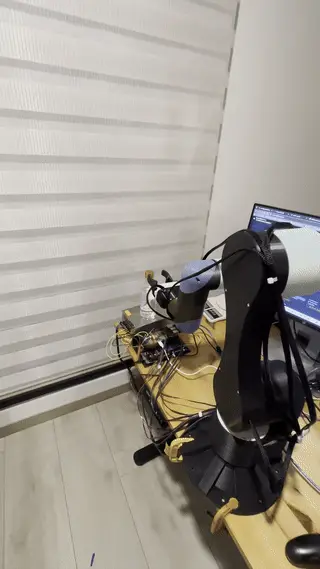
6-Axis 3D Printed Robot Arm with Wolfrom Gearboxes
por Bryand Salamanca en Thingiverse
6-Axis 3D Printed Robot Arm with Wolfrom Gearboxes A fully 3D printed 6-axis robot arm driven by NEMA 17 stepper motors and compact Wolfrom planetary gearboxes in every joint. No off-the-shelf bearings are used in the gearboxes: each output rides on a built-in ball bearing made of 7/32" steel balls.
Licencia
Uso comercial permitidoCC BY-SA 4.0 — Atribución, compartir igual
Puedes usarlo y modificarlo dando crédito; las versiones modificadas deben compartirse con la misma licencia.
Al descargar aceptas respetar la licencia y dar crédito a Bryand Salamanca.
Archivos (15)
- brazo_main_v2.step STEP · 33,0 MB
- brazo_main_v2.3mf 3MF · 8,7 MB
- base_1.obj OBJ · 457 KB
- base_tapa.obj OBJ · 82 KB
- base_torre.obj OBJ · 733 KB
- brazo.obj OBJ · 681 KB
- brazo_tapa.obj OBJ · 263 KB
- hombro.obj OBJ · 901 KB
- hombro_tapa.obj OBJ · 278 KB
- muneca_1.obj OBJ · 565 KB
- muneca_1_tapa.obj OBJ · 1,0 MB
- muneca_2.obj OBJ · 651 KB
- muneca_2_tapa.obj OBJ · 1,0 MB
- pinza.obj OBJ · 1,6 MB
- pinza_acople.obj OBJ · 255 KB
- Categoría
- Tecnología
- Formatos
- STEP, 3MF, OBJ
- Descargas
- 841
- Publicado
Sobre este modelo
6-Axis 3D Printed Robot Arm with Wolfrom Gearboxes A fully 3D printed 6-axis robot arm driven by NEMA 17 stepper motors and compact Wolfrom planetary gearboxes in every joint. No off-the-shelf bearings are used in the gearboxes: each output rides on a built-in ball bearing made of 7/32" steel balls running in a printed race. The arm is controlled by a BigTreeTech Octopus Pro with TMC2209 stepper drivers and a Raspberry Pi, which also drives the gripper servo. Features - 6 axes (J1–J6), each one with its own Wolfrom gearbox - Gearboxes: 3 × 96:1 herringbone, 1 × 82:1, 2 × 35:1 - Motors: NEMA 17 steppers (standard and pancake) - Height (upright): ≈ 875 mm - Link lengths: 270 mm (shoulder → elbow) and 200 mm (elbow → J4) - Base: Ø240 mm - Electronics: BigTreeTech Octopus Pro + 6 × TMC2209 + Raspberry Pi - Power: 24 V switching power supply, ~15 A - Gripper: servo on Raspberry Pi GPIO 16 - Open source Raspberry Pi software on GitHub - Editable files included so you can modify and improve the design
Joints JointMovementGearboxMotor J1Base rotationWolfrom 96:1 herringboneNEMA 17, 40 mm J2ShoulderWolfrom 96:1 herringboneNEMA 17, 60 mm J3ElbowWolfrom 96:1 herringboneNEMA 17, 40 mm J4ForearmWolfrom 82:1NEMA 17, 40 mm J5WristWolfrom 35:1NEMA 17 pancake J6Wrist rotationWolfrom 35:1NEMA 17 pancake The heavy joints near the base (J1–J3) use the 96:1 herringbone gearbox for maximum torque. The wrist uses the smaller and lighter 82:1 and 35:1 gearboxes to keep the weight at the end of the arm low. Each gearbox is also published on its own, with full details, tooth counts, hardware and assembly instructions: - Wolfrom 96 to 1 helicoidal: [link] - Wolfrom 82 to 1: [link] - Wolfrom 35 to 1: [link]
Electronics Power supply - 24 V switching power supply, ~15 A (≈360 W) - The one used in this build: https://es.aliexpress.com/item/1005003350556551.html - The 24 V output goes to the power input of the Octopus Pro, which feeds the board and the six stepper drivers.
BigTreeTech Octopus Pro + TMC2209 The six stepper motors are driven by a BigTreeTech Octopus Pro with TMC2209 drivers, one driver per joint. Each stepper plugs into the motor connector of its driver: JointDriverOctopus Pro motor connector J1TMC2209MOTOR0 J2TMC2209MOTOR1 J3TMC2209MOTOR2_1 J4TMC2209MOTOR3 J5TMC2209MOTOR4 J6TMC2209MOTOR5 MOTOR2_2 is left empty. Set the current of each TMC2209 according to its motor (the pancake motors on J5 and J6 need less current than the 40 mm and 60 mm motors). Raspberry Pi and gripper The Raspberry Pi is the main computer of the arm and is connected to the Octopus Pro by USB to send the motion commands. It is powered by its own 5 V USB-C supply. The gripper is driven by a servo connected to the Raspberry Pi: - Signal: GPIO 16 (physical pin 36) - GND: pin 34. The servo ground, the servo supply ground and the Raspberry Pi ground must be connected together. - Power: 5 V. A separate 5 V supply for the servo is recommended so it doesn't brown out the Raspberry Pi.
The model does not include a final gripper. The gripper end is left open so you can design the one that fits your application. The editable files are included so you can build your own.
Software The complete Raspberry Pi software to control the arm is available on GitHub: https://github.com/Bryand02/6-Axis-3D-Printed-Robot-Arm-with-Wolfrom-Gearboxes It is the full source code, so you can edit it, adapt it to your own build and add new features. Contributions are very welcome! It would be great to see people use it, fix bugs, add features and make it better. Feel free to open an issue, fork the repository or send a pull request. Printed parts PartDescription base (1)Base foot, Ø240 mm baseJ1 rotating tower, holds the J2 motor cover baseBase cover shoulderShoulder link (J2 → J3) cover shoulderShoulder side cover armArm link (J3 → J4) cover armArm side cover codo1Wrist piece (J4 → J5) codo inferiorJ5 round cover codo2Wrist piece (J5 → J6) codo superiorJ6 round cover union gripperMount between J6 and the gripper gripperGripper mount (base for your own gripper) Plus the parts of the six gearboxes (see each gearbox's page). Hardware - 6 × NEMA 17 stepper motors with a D-shaft (flat): 3 × 40 mm, 1 × 60 mm, 2 × pancake - Steel balls 7/32" (5.5 mm): 230 in total (3 × 50 for the 96:1, 30 for the 82:1, 2 × 25 for the 35:1) - M3 and M4 heat-set inserts and socket head screws (McMaster-Carr). See each gearbox's page for quantities. - BigTreeTech Octopus Pro - 6 × TMC2209 stepper drivers - Raspberry Pi + 5 V USB-C power supply - 1 × servo for the gripper + 5 V supply for the servo - 24 V ~15 A switching power supply
Print settings - Material: PETG recommended. - Layer height: 0.15–0.2 mm - Walls: 3 or more - Infill: 30–50 %
Recommendations - Build and test each gearbox on its own before mounting it in the arm. - Heat the motor shaft before pressing on each input sun gear. - Lubricate the gearboxes with white lithium grease. - Mind the output torque: the 96:1 gearboxes multiply the motor torque almost 100 times, which is more than printed parts can take. Limit the motor current according to the load. - Route the cables carefully so they don't get pinched when the joints move.
Credits - Hardware (screws and heat-set inserts) sourced from McMaster-Carr. - NEMA 17 motor models taken from GrabCAD and modified for this design.
Editable files: remix it! All the editable source files are included so you can modify the links, design your own gripper, change the gearbox ratios or adapt the arm to other motors. If you make a remix, please share it. I'd love to see what improvements come out of it. The same goes for the software: improvements to the code are welcome on the GitHub repository. License Creative Commons – Attribution – Share Alike Built one? Post your Make and let me know how it went!
Descripción original del autor, publicada en Thingiverse.